Beehiiv vs Kit.com vs Mailchimp: Which Grows a Newsletter Faster?
By Jonathan Miksis · Updated September 3, 2026 · 27 min read
Some links in this post are affiliate links. If you buy through one, I may earn a commission at no extra cost to you.
Growing a newsletter shouldn’t feel like pushing a boulder uphill. But for years, it did. I’ve used Mailchimp, Kit.com, and now Beehiiv across multiple digital businesses…and every time I switched platforms, my growth either exploded or stalled.
What shocked me was how much the platform itself affected my subscriber numbers. Same niche. Same content. Same promo strategy. But wildly different growth curves.
Most creators don’t realize this. They think slow growth means their content isn’t good enough. Or they need to post more. Or their niche is “too competitive.” But the truth? Your email platform can make or break your growth.
One of these tools helped me grow my list faster than anything else I’ve tried. Another slowed me down even though it has great automations. And the last one… well, it’s basically a corporate dinosaur at this point.
In this breakdown, I’ll give you the real creator-focused comparison of Beehiiv vs Kit.com vs Mailchimp. I’m covering actual growth tools, deliverability, viral loops, pricing, and what happened when I personally used each platform to scale newsletters, landing pages, and funnels.
If you’re trying to choose the best newsletter platform for growth in 2026, this will save you months of trial and error.
👉 Subscribe for my free tool and prompt stack (the one that has automated my email marketing)
Beehiiv vs Kit.com vs Mailchimp: the quick answer
Short on time? Here's how the three stack up after I ran all of them across multiple six-figure newsletters:
| Beehiiv | Kit.com (formerly ConvertKit) | Mailchimp | |
|---|---|---|---|
| Best for | Fast newsletter growth | Automations and funnels | All-in-one marketing |
| Built-in growth | Yes: recommendations, boosts, referrals, from the free plan | Partial: paid recommendations and a referral system, mostly on paid plans | Minimal |
| Automations | Good and improving | Best-in-class | Capable but clunky |
| Landing pages | Fast, high-converting | Solid | Average |
| Deliverability | Strong | Excellent | Mixed |
| Free plan (as of September 2026) | Up to 2,500 subscribers | Up to 10,000 subscribers, limited automation | 250 contacts, 500 sends a month |
| Pricing as you scale | Gentlest curve of the three from 10,000 subscribers up | Creeps up | Most expensive |
My pick for growing a newsletter fast: Beehiiv. Its built-in growth tools (recommendations, boosts, and a referral program) compound in a way the others can't. Go with Kit.com if you're funnel- and automation-first, and keep Mailchimp only if you need a broad all-in-one marketing suite. The full breakdown, with pricing and deliverability, is below. Only weighing two? Jump to Beehiiv vs Mailchimp or Beehiiv vs Kit (ConvertKit).
The Real Question: What Actually Drives Fast Newsletter Growth?
Most people compare email platforms the wrong way. They obsess over templates, automations, or how pretty the dashboard looks. I’ve done that too. But after growing multiple newsletters across Beehiiv, Kit.com, and Mailchimp, I learned something that changed everything:
Speed comes from systems, not aesthetics.
If you want to grow a newsletter fast, only three things actually matter:
1. How easy it is for someone to subscribe
Your landing pages, forms, and magic-link options matter more than any template. When a platform makes the signup flow frictionless, your list grows on autopilot.
2. Whether the platform has built-in growth features
This is where platforms separate fast vs. slow.
Referral systems, recommendations, boosted posts, viral loops…these aren’t “nice to have.” They’re the difference between adding 10 subs a week and adding 100.
3. Deliverability + smart automations
If your emails land in spam or you can’t nurture subscribers instantly, growth stalls. Consistent inboxing + simple automation = faster trust building.
I used to think growth was all about writing better emails. But once I switched platforms and watched my numbers jump without changing my content, it was obvious:
Your email platform is either accelerating your growth… or quietly killing it.
Now let’s break down Beehiiv, Kit.com, and Mailchimp with that lens. The only lens that actually matters if your goal is fast, compounding newsletter growth.
What Creators Actually Care About
I’ve built newsletters on all three platforms, and here’s the truth:
Your newsletter grows faster when your platform removes friction, amplifies visibility, and makes it stupid-easy for people to subscribe.
So instead of giving you a giant checklist, here’s the only comparison that matters if your goal is growth, simplicity, and actually hitting “send” every week.
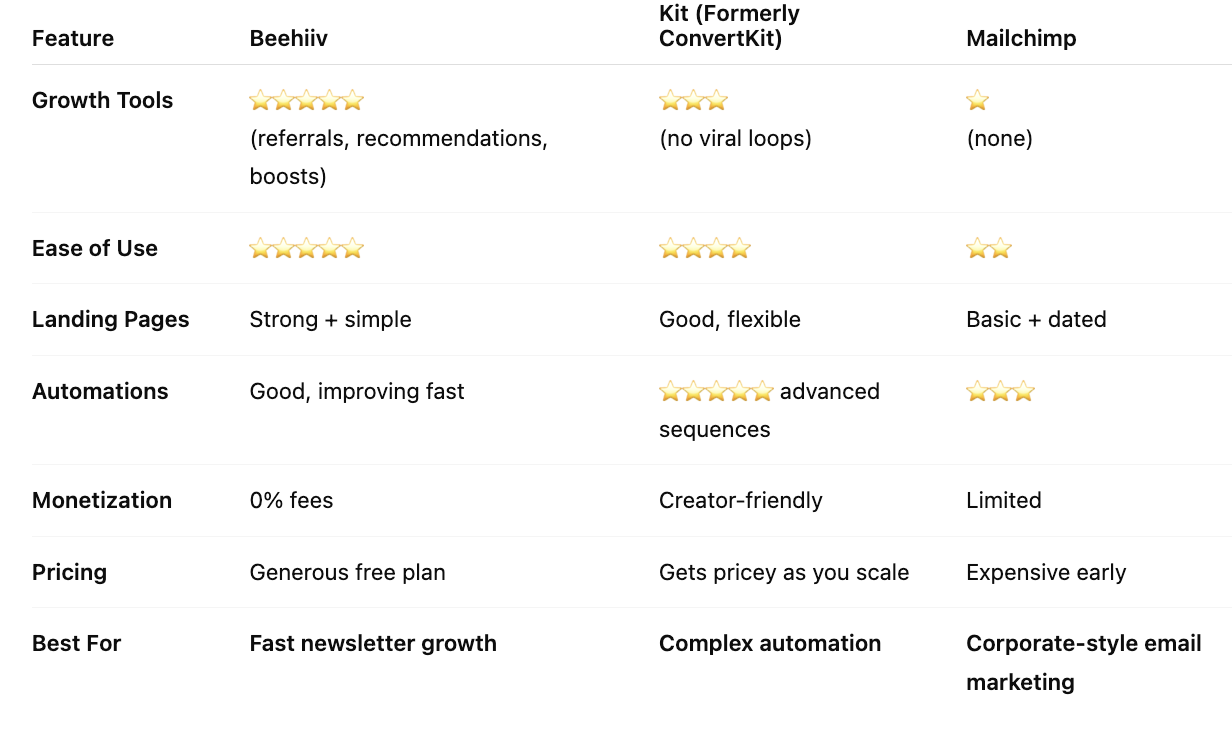
My table comparing Beehiiv, Kit.com, and Mailchimp
Beehiiv
If you care about growing your audience fast, Beehiiv is the easiest win.
The built-in recommendation network and referral system alone can grow your list while you sleep. No other platform gives you that.
Kit.com (formerly ConvertKit)
If you love advanced automations, segmentation, and building multi-step funnels, Kit.com is still powerful. It’s clean and flexible, but growth depends on you, not the platform.
Mailchimp
Still decent for corporate teams or anyone who wants templates and brand-heavy newsletters. But for creators? It’s slow, clunky, and not built for growth.
My Thoughts…
If your goal is speed, go Beehiiv.
If your goal is automation, go Kit.com.
If your goal is “looks familiar,” go Mailchimp.
Beehiiv Breakdown: Why Creators Are Switching Fast
I’ll be straight with you: the first time I tried Beehiiv, I expected it to be another “cool new platform” that felt good on the surface but didn’t actually move numbers. I was wrong.
Beehiiv is the only platform where my subscriber count grew without me grinding harder. Not because I suddenly wrote better content, but because Beehiiv has growth features the other platforms simply don’t.
Here’s why creators keep moving to Beehiiv, and why I now use it as my default newsletter engine:
1. Built-in virality (this is the cheat code)
Beehiiv has the growth loops baked in:
Recommendations
Magic links
Referrals
Boosts
These aren’t gimmicks. They work.
The first week I turned on recommendations, I gained subscribers I didn’t even promote to. No ad spend. No cross-promo deals. Just the ecosystem doing its thing.
2. Landing pages that don’t make you want to scream
Beehiiv’s landing pages are simple by design, and that’s why they convert. Clean layouts, fast load times, and no overthinking required. I’ve tested Beehiiv pages against Mailchimp and Kit.com, and Beehiiv consistently wins on raw signup rate.
3. Zero-fee monetization = more money stays in your pocket
If you’re planning paid newsletters, Beehiiv’s Scale and Max plans take a 0% cut of subscription revenue (as of September 2026). Apart from card processing, the money is yours. For comparison, Kit’s free plan charges 3.5% plus 30 cents per digital product sale.
4. The workflow actually feels fun
This matters more than people admit. When you enjoy hitting “send,” you publish more often. And publishing more = faster growth.
Beehiiv has this rare balance of power + simplicity that makes writing and sending feel natural. No clutter. No endless settings. Just write → send → grow.
5. Creator-focused, not corporate-focused
Beehiiv feels like it was built for the solo operator, the creator, the indie publisher. Kit.com is better for complex funnels. Mailchimp is better for brands and big teams.
But Beehiiv? It’s built for speed, and built for people who want to grow, not tinker.
My Bottom Line on Beehiiv
If you want newsletter growth without reinventing your entire workflow, Beehiiv is the platform I recommend. It’s the one I use. It’s the one I trust. And it’s the only one where growth feels baked in from day one.
👉 Start your Beehiiv newsletter (free), and pair it with my growth prompts to accelerate even faster.
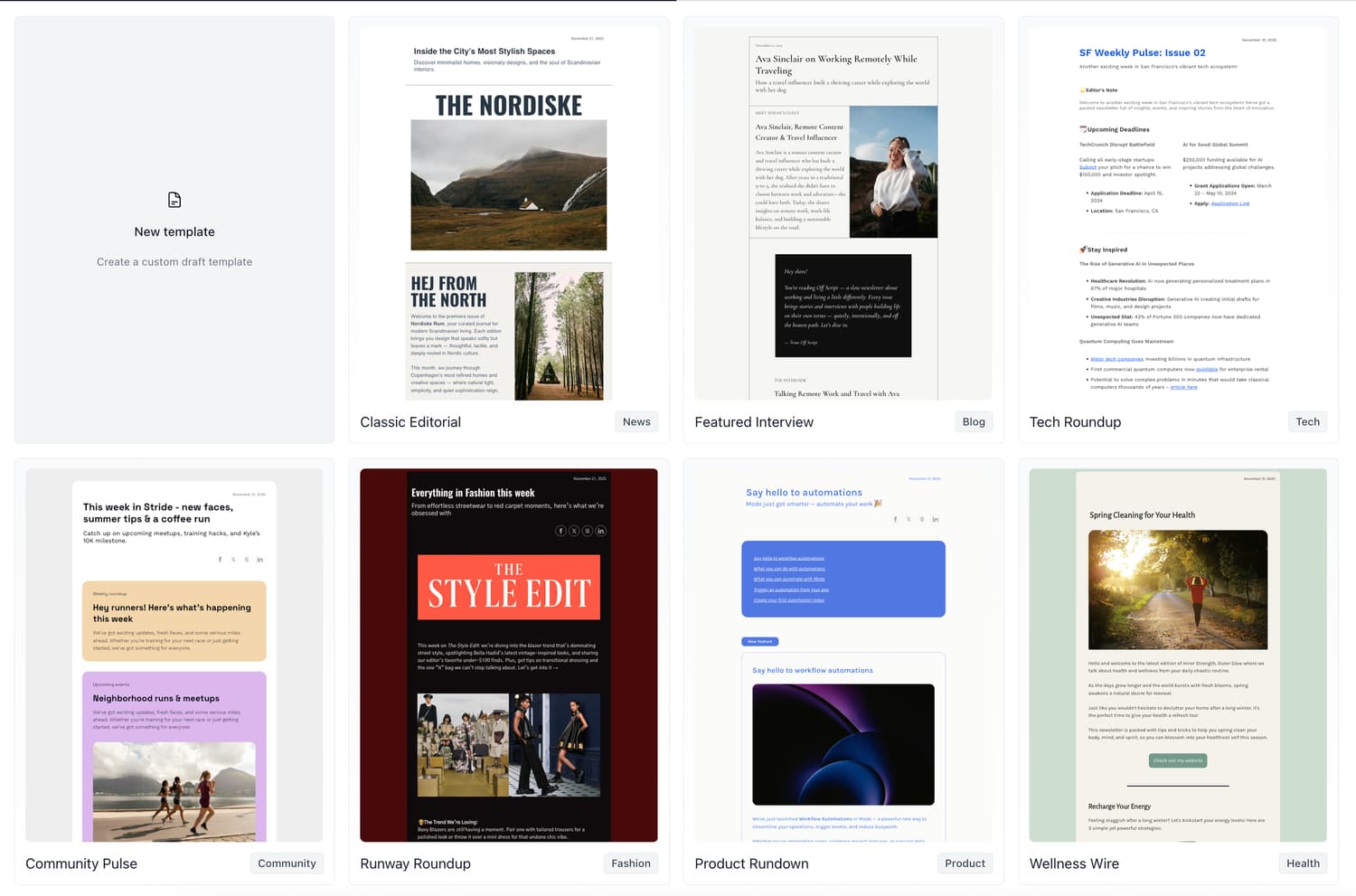
I love Beehiiv’s email newsletter templates
Kit.com: Where It Wins and Where It Slows You Down
Kit.com (formerly ConvertKit) has been a powerhouse in the creator space for years. I’ve used it across multiple funnels, product launches, and email sequences, and when it comes to automation, Kit.com is still one of the strongest platforms out there.
But if you want fast growth, it falls short in a few key areas. Not because it’s bad… but because it was built with a different philosophy than Beehiiv.
Here’s the real-world breakdown from someone who’s built profitable funnels on both.
1. Automations Are Still Best-in-Class (This Is Where Kit.com Shines)
If you love mapping subscriber journeys, tagging segments, and building “if/then” logic, Kit.com is your playground.
It does automation better than any creator-focused platform, period.
When I was running more complex funnels, onboarding sequences, upsell paths, lead scoring, Kit.com handled all of it cleanly.
No hacky workarounds. No fighting the UI.
Just smooth, logical setups that fire exactly when you expect them to.
If that’s your priority, Kit.com might be the best choice.
2. The Downside: Growth Depends Entirely on You
Here’s the friction I ran into:
Kit.com doesn’t have the built-in viral loops that Beehiiv gives you from the free plan. It has added paid recommendations (Kit takes a 23.5% fee, and you need a paid plan) and a referral system on the Pro plan, but there is no free recommendation network or magic-link flow that compounds growth on its own.
So anytime I wanted to grow faster on Kit.com, I had to push harder:
More content
More collaborations
More promotions
More manual effort
Nothing wrong with that… but it means growth is on you, not the platform.
Beehiiv grows with you.
Kit.com grows because of you.
That’s a big difference.
3. Landing Pages Are Good: But Not Built for Speed
Kit.com’s landing page builder is flexible and clean. I’ve used it for lead magnets, waitlists, and product funnels.
But compared directly to Beehiiv?
Beehiiv wins on:
Faster load times
Simpler layouts
Higher default conversions
Kit.com pages look great, but design flexibility can be a trap. The more choices you give a creator, the easier it is for them to overthink everything.
I’ve fallen into that trap many times.
4. Pricing Gets Painful As You Scale
When your list is small, Kit.com feels affordable.
Once you start growing fast, the pricing jumps hit hard.
I’ve had months where I scaled quickly and watched my bill climb right alongside it.
Beehiiv’s free plan and predictable pricing make growth feel… safer.
5. Great for Funnels. Not the best for newsletter-first growth.
This is the cleanest way to say it:
If you’re a funnel-heavy creator → Kit.com is strong.
If you’re a newsletter-first creator → Beehiiv is faster.
I’ve run both models, and Kit.com always wins on logic and automation… but Beehiiv wins on raw audience growth.
My Bottom Line on Kit.com
Kit.com is still one of the best tools for creators who want smart automation, segmentation, and clean subscriber management.
But if your #1 goal is to grow your newsletter quickly, Kit.com isn’t built for that kind of compounding momentum.
👉 If you want automations, Kit.com is fantastic.
👉 If you want speed, Beehiiv is the move.
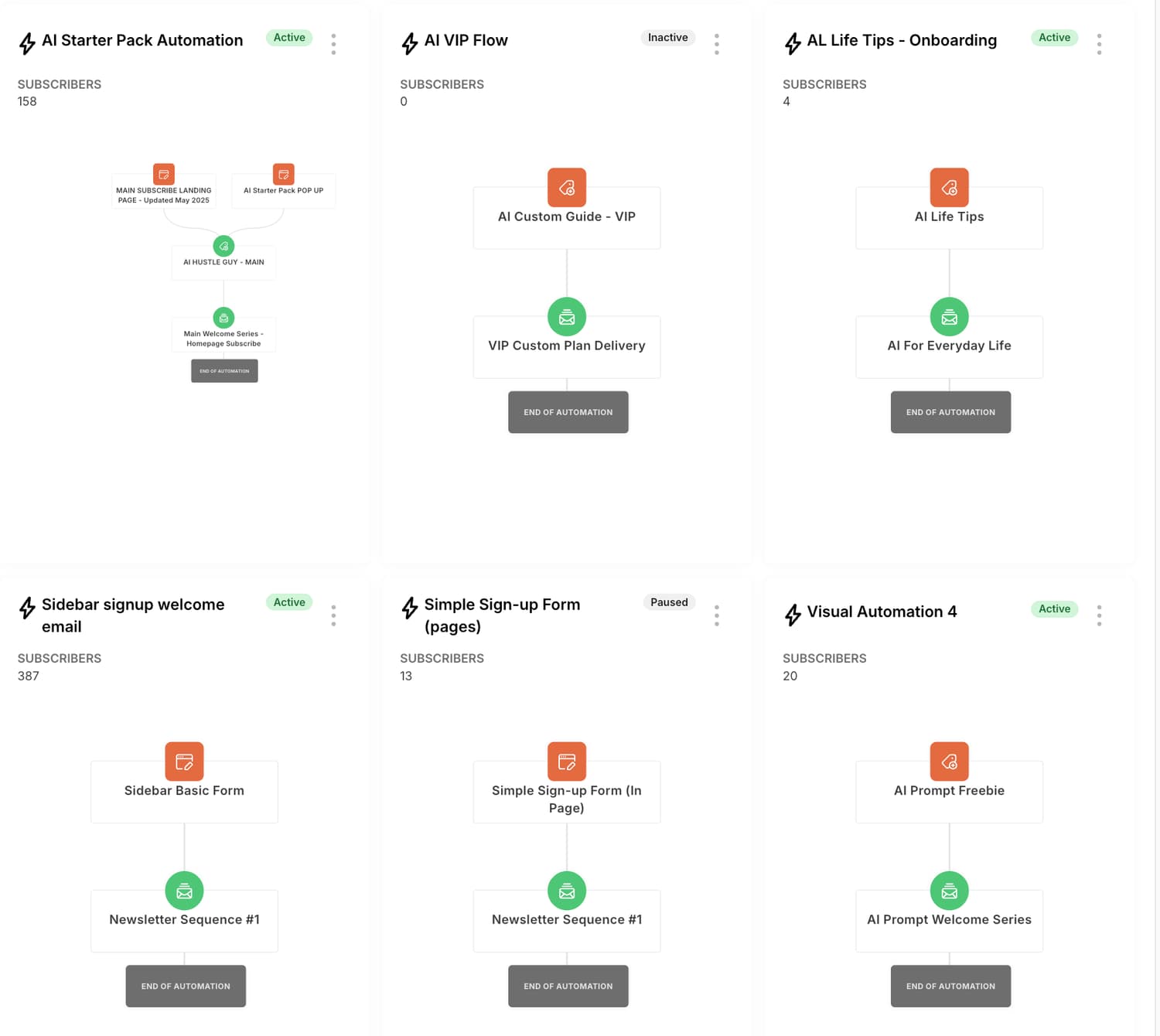
A few automations on my Kit.com account for two websites I own
Mailchimp: The OG That’s Showing Its Age
Mailchimp was the first email platform I ever used. Back then, it felt like every entrepreneur started their newsletter on Mailchimp because… well, that’s just what everyone did.
But after building multiple lists across Mailchimp, Kit.com, and Beehiiv, here’s the truth:
Mailchimp works, but it works in that “corporate tool from 2012” kind of way.
It’s functional…not fast. Capable, but not creator-friendly.
If you're a solo operator or content creator trying to grow a newsletter quickly, Mailchimp feels like dragging a wagon uphill. It actually started causing some big problems on my Wordpress site a couple of years ago.
Let me break it down.
1. The UX Feels Heavy and Overbuilt
Mailchimp isn’t “bad.” It’s just built for a different type of user.
Large teams.
Corporate marketers.
People who need brand consistency and templates across departments.
But when you’re a creator?
It feels slow, clunky, and full of settings you never asked for.
Every time I logged in, I felt like Mailchimp wanted me to build a campaign… not a newsletter.
2. Zero Built-In Growth Features
This is the deal-breaker.
Mailchimp has:
No referral engine
No recommendations
No native virality
No magic links
No growth loops
Which means this:
Your list only grows if you manually hustle for every subscriber.
No compounding.
No network effects.
No help from the platform.
When you see creators exploding to 10k, 20k, 50k subscribers… they aren’t doing it on Mailchimp. There’s a reason for that.
3. Landing Pages Are… Fine. But Not High-Converting
Mailchimp’s landing pages look like something you’d use if you were trying to promote a local event, not build a fast-growing digital business.
They’re functional, but they don’t hit the level of simplicity or conversion power that Beehiiv and Kit.com bring.
I’ve split-tested Mailchimp pages vs. Beehiiv’s:
Beehiiv wins every time.
Mailchimp didn’t even come close.
4. Pricing Gets Expensive Fast
Mailchimp has the classic “cheap at first, expensive later” business model.
It feels free and friendly in the beginning…
then hits you with a wall of pricing tiers as soon as you start gaining momentum.
As a creator scaling a newsletter, that’s the last thing you want to worry about.
5. Still Useful for Certain People
I’m not here to trash Mailchimp. It still has a place.
It’s good if:
You’re running a local business
You want branded email templates
You need team access + roles
You’re sending campaigns, not newsletters
But for creators? For growth? For speed?
It’s not the one.
Bottom Line on Mailchimp
Mailchimp is a safe, familiar option, but not a fast-growth platform. If you’re a creator who wants momentum, simplicity, and better conversions, Beehiiv or Kit.com will serve you better.
👉 TL;DR: Mailchimp is fine. But “fine” doesn’t scale a newsletter.
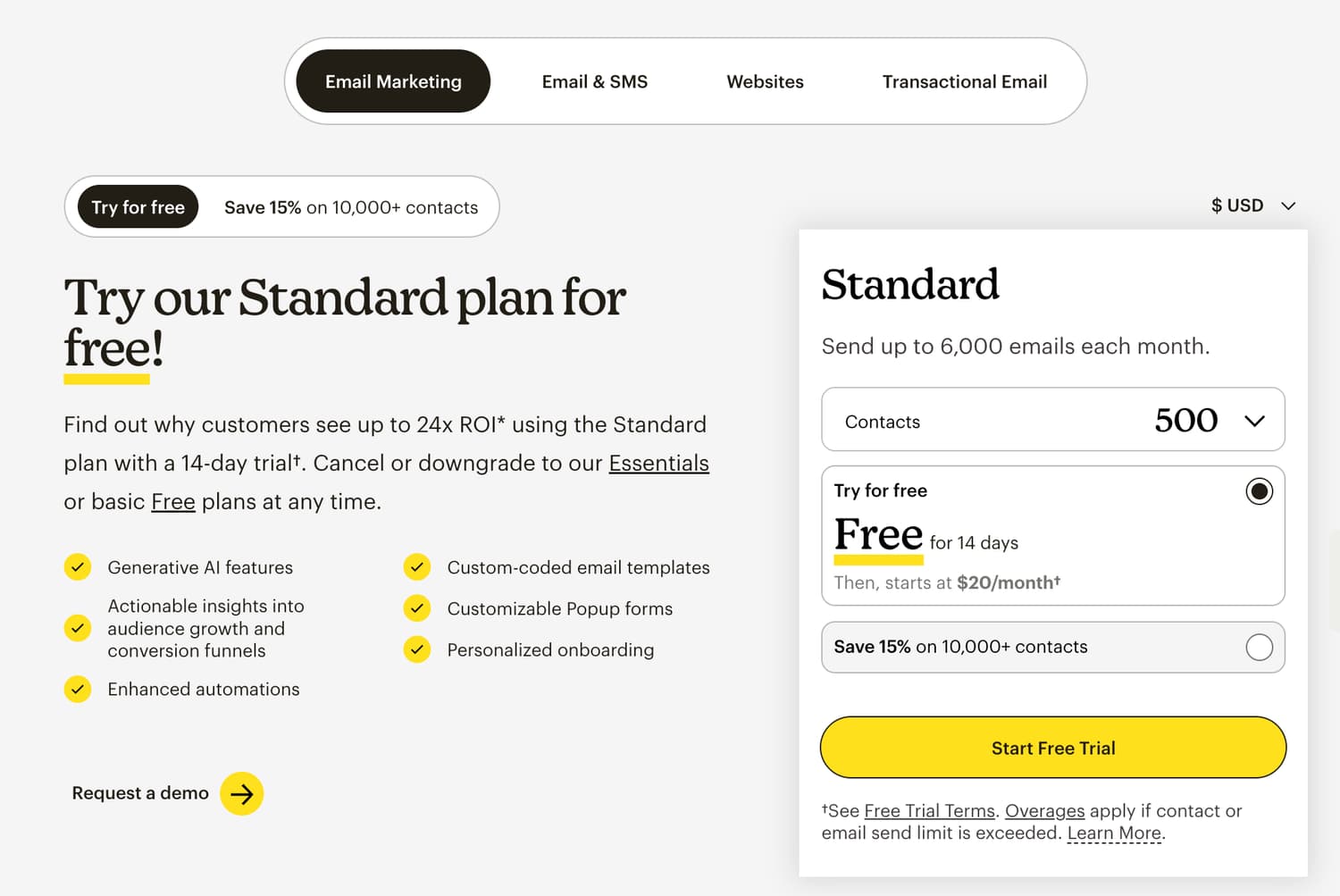
Current Mailchimp promo for the standard plan
Email Deliverability: Who Actually Hits the Inbox More?
Here’s something creators don’t talk about enough:
if your emails don’t hit the inbox, nothing else matters.
I’ve had launches where deliverability alone swung revenue up or down. Same copy. Same offer. Completely different results, simply because one platform delivered cleanly and another didn’t.
Here’s the real-world breakdown of Beehiiv vs Kit.com vs Mailchimp when it comes to deliverability:
1. Beehiiv: Surprisingly Strong (Especially for Creators)
Beehiiv’s deliverability has improved massively over the last year.
My open rates are consistently high, especially with:
Clean import tools
Strong default sending infrastructure
Clear monitoring tools
Automatic warmup assistance
Straightforward DNS setup
Most importantly: Beehiiv’s audience tends to be creator-focused, not spammy, which helps the entire ecosystem maintain strong sender reputation.
It’s simple and it works.
2. Kit.com: Excellent Deliverability, Especially for Funnels
Kit.com has always been known for great inbox placement.
Their infrastructure is dialed in, and if you’re doing:
Lead nurturing
Multi-step email funnels
Segmented campaigns
Automated journeys
…Kit.com’s deliverability stays rock-solid.
Opens and clicks remain stable even during heavy automation weeks.
If you care about deep funnels or behavior-based sequences, Kit.com’s deliverability is a major selling point.
3. Mailchimp: A Mixed Bag
Mailchimp can deliver well… if your list is pristine, highly warmed up, and branded.
But in my experience:
Creators see lower engagement
Lists with varied sources hit more spam filters
Mailchimp is stricter about list imports
Campaign-style emails sometimes get flagged
For corporate newsletters, it’s fine.
For creators trying to grow? It feels uneven.
So Who Actually Wins Deliverability?
If you’re a creator running a newsletter:
1. Beehiiv, consistently strong for simple newsletters
2. Kit.com, best for complex automation and heavy email volume
3. Mailchimp, okay, but inconsistent and overly restrictive
All three can work… but I’ve never regretted sending from Beehiiv or Kit.com.
Mailchimp? Plenty of regrets.
Pricing Comparison: What You Actually Pay As You Grow
Most platforms hook you with a cheap starter plan, then quietly crank up the price once your list starts growing. I’ve felt that pain personally, especially during big growth months where your subscriber count jumps fast.
Here’s the real breakdown of Beehiiv vs Kit.com vs Mailchimp from someone who’s paid for all three. All figures below are as of September 2026, checked against each platform’s official pricing page. Prices change often, so confirm on the pricing page before you commit.
1. Beehiiv: Gentlest Price Curve Once You Pay
Beehiiv is the most generous platform when you’re just starting out. One correction to an earlier version of this post: the Scale plan is not a flat $43 all the way to 100,000 subscribers. It tiers up with your list, just more gently than the others.
| Beehiiv plan (September 2026) | Price | What you get |
|---|---|---|
| Launch | $0 | Up to 2,500 subscribers, unlimited sends, recommendation network, custom domain, website |
| Scale | From $43/month billed annually ($517/year), about $49 month to month, for up to 1,000 subscribers | Ad network, 0% take rate on paid subscriptions, email automations, digital products, surveys, webhooks |
| Max | From $96/month billed annually ($1,151/year), about $109 month to month, for up to 1,000 subscribers | Everything in Scale, remove Beehiiv branding, up to 10 publications, unlimited team seats, priority support |
| Enterprise | Custom | 100,000+ subscribers, dedicated IPs, dedicated account manager |
How Scale climbs on annual billing: $61/month at 2,500 subscribers, $78 at 5,000, $96 at 10,000, $149 at 25,000, $219 at 50,000 and $290 at 100,000. Max runs $131, $149, $193, $254, $334 and $404 at the same tiers.
The biggest win is the shape of the curve. From about 10,000 subscribers upward, Beehiiv is the cheapest of the three at every tier in the tables below, and the free plan covers a list ten times bigger than Mailchimp’s.
2. Kit.com: Strong Features, Price Creeps Up
Kit raised prices in September 2025 and now calls its plans Newsletter, Creator and Pro, so if you last looked a year ago, the numbers have moved.
| Kit plan (September 2026) | Price | What you get |
|---|---|---|
| Newsletter (free) | $0 | Up to 10,000 subscribers, unlimited broadcasts, landing pages and forms, limited automation, digital product sales at 3.5% plus 30 cents per transaction |
| Creator | $39/month, or $33/month billed annually ($390/year), for up to 1,000 subscribers | Unlimited visual automations and sequences, A/B testing, integrations, RSS campaigns, 24/7 support |
| Pro (formerly Creator Pro) | $79/month, or $66/month billed annually ($790/year), for up to 1,000 subscribers | Everything in Creator, newsletter referral system, engagement scoring, deliverability reporting, unlimited users, Facebook custom audiences, sponsorships |
How Creator climbs on monthly billing: about $89/month at 5,000 subscribers, $139 at 10,000 and $199 at 25,000. Pro runs about $139, $189 and $279 at the same tiers, and annual billing takes roughly two months off either plan. Kit does not publish a 50,000-subscriber price in the same table, so check current pricing for lists that size. One thing in Kit’s favour: it bills only active subscribers, not unsubscribed or duplicate contacts.
You’re paying for:
Best-in-class automations
Flexible segmentation
Creator-friendly workflows
High deliverability
It’s worth it if you love automation or run multiple funnels. But if you’re growing quickly and don’t need heavy automation, Kit.com can feel expensive fast.
I’ve had months where my subscriber count spiked and my Kit.com bill jumped right with it.
3. Mailchimp: The Most Expensive (Especially Long-Term)
Mailchimp cut its free plan in January 2026 (it used to cover 500 contacts and 1,000 sends), so the on-ramp is now tiny and the paid tiers climb with every contact you store.
| Mailchimp plan (September 2026) | Price | What you get |
|---|---|---|
| Free | $0 | 250 contacts, 500 sends a month (250 a day), basic campaigns and forms |
| Essentials | From $13/month for 500 contacts | Scheduling, A/B testing, up to 4 automation steps, sends capped at 10x your contacts |
| Standard | From $20/month for 500 contacts | Up to 200 automation flows, generative AI, custom-coded templates, sends capped at 12x contacts |
| Premium | From $350/month for 10,000 contacts | Phone support, predictive segmentation, dedicated onboarding, up to 150,000 sends a month |
How it climbs (monthly billing, approximate): Essentials runs about $75/month at 5,000 contacts, $110 at 10,000, $270 at 25,000 and $385 at 50,000. Standard is about $100, $135, $310 and $450 at the same tiers, and Premium reaches roughly $620 at 25,000 and $815 at 50,000. Mailchimp bills on the contacts stored in your audience, not the emails you send, so a quiet month costs the same as a busy one.
It’s a classic corporate SaaS move: “Affordable until you really need us.”
Side by Side: What Each Platform Costs at Your List Size
| Subscribers | Beehiiv Scale (annual billing) | Kit Creator (monthly billing) | Mailchimp Standard (monthly billing) |
|---|---|---|---|
| Up to 1,000 | $43 | $39 | From $20 at 500 contacts |
| 2,500 | $61 | Check current pricing | Check current pricing |
| 5,000 | $78 | About $89 | About $100 |
| 10,000 | $96 | About $139 | About $135 |
| 25,000 | $149 | About $199 | About $310 |
| 50,000 | $219 | Check current pricing | About $450 |
| 100,000 | $290 | Check current pricing | Check current pricing |
Beehiiv publishes annual-billing prices, while the Kit and Mailchimp figures are month to month and Kit’s annual billing knocks roughly two months off. Even allowing for that, the order from 10,000 subscribers upward is Beehiiv, then Kit, then Mailchimp.
Pricing Verdict
Under 10,000 subscribers with no automation needs, Kit’s free plan is the cheapest option of the three. Once you are paying, Kit and Beehiiv are within a few dollars of each other up to about 5,000 subscribers, then Beehiiv pulls ahead and the gap widens: at 25,000 subscribers you pay $149 on Beehiiv against about $199 on Kit and $310 on Mailchimp.
If you care about affordable growth, Beehiiv wins.
If you care about advanced automation, Kit.com justifies the cost.
Mailchimp ONLY makes sense if your brand requires it, otherwise, it’s overpriced for what creators get.
Beehiiv vs Mailchimp
Verdict: if the newsletter is the product, Beehiiv beats Mailchimp on growth tools, free plan, deliverability and price, and Mailchimp only earns its keep if you need its wider marketing suite.
Beehiiv vs Mailchimp is really a comparison across two eras of email. Mailchimp is the legacy all-in-one: email with a broad marketing suite bolted around it, built for small businesses and marketing teams. Beehiiv was built newsletter-first, with growth mechanics baked in and pricing designed for creators. One line: Beehiiv grows newsletters, Mailchimp manages marketing.
| Beehiiv | Mailchimp | |
|---|---|---|
| Built for | Newsletter-first creators | All-in-one marketing |
| Built-in growth tools | Recommendations, boosts, referrals | Minimal |
| Monetization | Ad network, paid subscriptions with 0% take on Scale | Not newsletter-native |
| Automations | Good and improving | Capable but clunky |
| Deliverability | Strong | Mixed |
| Free plan (September 2026) | Up to 2,500 subscribers, unlimited sends | 250 contacts, 500 sends a month |
| Price at 10,000 subscribers | $96/month on annual billing | About $135/month on Standard |
Where Beehiiv wins. Growth is a feature, not your problem alone. The recommendations network, boosts and referral program compound subscriber growth in a way no legacy platform matches, and the ad network plus paid subscriptions mean the platform helps you earn, not just send. The free plan covers ten times as many subscribers as Mailchimp’s, and the paid curve is far gentler: at 25,000 subscribers you pay $149 a month on Beehiiv against about $310 on Mailchimp Standard.
Where Mailchimp wins. Breadth. Ecommerce journeys, audience segmentation across channels, landing pages, postcards, and integrations with practically everything. If your email list is one arm of a broader marketing operation for an online store or local business, that suite has real value. Where it falls short is the newsletter experience itself: automations feel clunky next to modern tools, growth tools are minimal, and in my experience deliverability is mixed once your list has varied sources.
Switching from Mailchimp to Beehiiv. Export your audience from Mailchimp as a CSV, import it into Beehiiv, point your signup forms at the new platform and set up your sending domain. The list move itself is an afternoon’s work. The bigger job is rebuilding automations, which Beehiiv keeps simple.
Ask what email is for in your business. If the newsletter is the product or the audience engine, choose Beehiiv. If email is one channel inside a marketing suite you also need, Mailchimp earns its keep, just budget for the price curve.
Beehiiv vs Kit (ConvertKit)
Verdict: Beehiiv is the better choice when growing the list is the job, and Kit (formerly ConvertKit) is the better choice when you already have readers and need automations and funnels that sell.
These are the two platforms genuinely built for creators, and unusually for a comparison post, I pay for both. Beehiiv and Kit each run real newsletters in my business, and this site’s own emails go through Kit. They optimize for different engines. One line: Beehiiv grows the audience, Kit monetizes the relationship.
| Beehiiv | Kit (ConvertKit) | |
|---|---|---|
| Built for | Newsletter growth | Creator funnels and automation |
| Built-in growth tools | Recommendations, boosts, referrals, included on the free plan | Paid recommendations (23.5% Kit fee, paid plans) and a referral system on Pro |
| Automations | Good and improving | Best-in-class |
| Monetization | Ad network, paid subscriptions with 0% take on Scale | Digital products, tip jars, paid newsletters, sponsorships on Pro |
| Deliverability | Strong | Excellent |
| Free plan (September 2026) | Up to 2,500 subscribers | Up to 10,000 subscribers, limited automation |
| Price at 10,000 subscribers | $96/month on annual billing | About $139/month on Creator, billed monthly |
Where Beehiiv wins. Beehiiv treats growth as the product. The recommendations network puts your newsletter in front of other newsletters’ readers, boosts let you pay (and get paid) for quality referrals, and the referral program turns readers into recruiters. No other platform compounds an audience like this out of the box, and it is switched on from the free plan. Where it falls short: automations are good but not Kit-deep. Complex tagging, branching funnels and product-launch sequences are where you feel the gap.
Where Kit wins. Kit is still the automation king for creators. The visual automation builder, granular tagging and sequence logic let you run sophisticated funnels (welcome series that adapt to clicks, launch sequences, evergreen sales flows) without duct tape. Deliverability is excellent, and the creator commerce features are mature. Its free plan is also bigger than people realize: up to 10,000 subscribers, though with limited automation, which is exactly the feature you would come to Kit for. Where it falls short: growth is mostly on you, and the paid tiers climb faster than Beehiiv’s from about 10,000 subscribers up.
Which is cheaper? At small list sizes Kit is cheaper, and its 10,000-subscriber free plan is hard to beat if you only need broadcasts. Past 10,000 subscribers Beehiiv pulls ahead: $96 a month at 10,000 and $149 at 25,000 on annual billing, against about $139 and $199 on Kit’s Creator plan billed monthly. If you expect fast growth, price the destination, not the start.
Can you switch later? Yes. List export and import is straightforward on both. The friction is rebuilding automations (moving to Beehiiv) or replacing growth mechanics (moving to Kit), so pick for your next 12 months, not forever.
Be honest about your bottleneck. If the audience is small and growth is the job, start with Beehiiv. If the audience exists and monetization is the job, Kit pays for itself. Some operators, me included, run Beehiiv for a growth-first publication and Kit for the funnel-driven list.
Which Platform Actually Grows a Newsletter Faster? (Final Verdict)
After running newsletters, funnels, and digital products on all three platforms… here’s the truth I wish someone told me years ago:
If your goal is fast, compounding newsletter growth, Beehiiv wins.
If your goal is advanced automation and segmentation, Kit.com wins.
**If your goal is corporate-style email campaigns, ** Mailchimp is fine but not built for creators.
Growth is the metric that matters most.
And Beehiiv is the only platform where my subscriber count grew even when I wasn’t actively promoting.
The built-in referral system, recommendations, magic links, and the overall creator ecosystem do something the others simply don’t: they remove friction and give you momentum.
When I moved my main newsletter to Beehiiv, I saw the difference almost immediately. Same content. Same cadence. Same niche.
But the numbers moved faster because the platform helped push them.
Kit.com still plays an important role in my world, especially when I’m building complex funnels or running multi-step onboarding. It’s powerful and reliable.
Mailchimp… I’ve outgrown it. It served its purpose early on, but creators scaling newsletters in 2026 need more than templates and campaigns.
So here’s the cleanest way to think about it:
Want to grow fast? Start with Beehiiv.
Want advanced logic and automation? Consider Kit.com.
Want a familiar, corporate-style email tool? Mailchimp’s there.
But if I had to start over today, from scratch, with zero subscribers and one goal, grow a newsletter that turns into a real business, I’d choose Beehiiv every time.
Enjoyed reading my blog post?
👉 Subscribe for my free tools + prompt pack, you’ll get the stack I use to build high-converting landing pages, automate follow-ups, and grow every funnel I run.
Frequently asked questions
Is Beehiiv better than Mailchimp? For a creator growing a newsletter, yes. Beehiiv ships with a recommendation network, boosts and a referral program, and its free plan covers 2,500 subscribers, while Mailchimp's free plan is capped at 250 contacts and 500 sends a month as of September 2026. Mailchimp only wins if you need its broader all-in-one marketing suite for ecommerce or multi-channel campaigns. Full breakdown in Beehiiv vs Mailchimp above.
Is Beehiiv or Kit better for a newsletter? Beehiiv is better if growth is your bottleneck, because its recommendations, boosts and referral program bring in subscribers the platform helps you find. Kit (formerly ConvertKit) is better if you already have an audience and need deep automations, tagging and product funnels. I pay for both: Beehiiv for growth-first publications and Kit for the funnel-driven list, including this site's own emails. See Beehiiv vs Kit (ConvertKit) above.
Is Beehiiv free? Yes. Beehiiv's Launch plan is free for up to 2,500 subscribers with unlimited sends, a custom domain and the recommendation network included, as of September 2026. Paid plans start at $43 a month on annual billing (about $49 month to month) for up to 1,000 subscribers and rise with your list size.
Which is cheaper, Beehiiv or Kit? It depends on list size. Kit's free plan goes to 10,000 subscribers versus Beehiiv's 2,500, so a small list with no automation needs is cheaper on Kit. Once you are paying and past roughly 10,000 subscribers, Beehiiv is cheaper: $96 a month on annual billing at 10,000 subscribers versus about $139 a month for Kit's Creator plan billed monthly, as of September 2026, and the gap widens at 25,000.
Should I switch from Mailchimp to Beehiiv? If newsletter growth is the goal, yes, and the move is less painful than it sounds. Export your audience from Mailchimp as a CSV, import it into Beehiiv, point your signup forms at the new platform and set up your sending domain. The bigger job is rebuilding automations, which Beehiiv keeps simple, and in return you get the growth tools and a far gentler price curve.
Is Kit the same as ConvertKit? Yes. ConvertKit rebranded to Kit in 2024 and now lives at kit.com. It is the same platform with the same automation strengths, and as of September 2026 its plans are called Newsletter (free), Creator and Pro.
Related reading
- 12 AI Prompts to Build a Personal Brand (Even If You Hate Writing)
- Prompt Engineering for Gemini: The Skills Google Wants You to Learn
- My Top 20 AI Image Prompts for Midjourney, ChatGPT & Nano Banana


Written by Jon Miksis
Founder of AI Hustle Guy, Make the Leap, and Europe Flight Club, and the travel blogger behind Global Viewpoint (9+ years, 73 countries). He brings 9+ years of coaching and mentorship experience and has facilitated 23 transformation retreats across four continents. Every AI tool and prompt on this site gets tested on his own businesses first.
Get my free AI prompt pack
Join 300+ founders, creators, and professionals. I’ll send you my go-to AI tools and copy-paste prompts that save hours every week. No spam.