The 7 Best AI Career Tools in 2026 (for Career Changers, Not Just Resumes)
By Jonathan Miksis · August 23, 2026 · 13 min read
Search for AI career tools and you will find a dozen listicles that are really resume-builder roundups wearing a trench coat. Grammarly and a presentation app are not going to tell you what to do with your life.
This list is about the harder problem: figuring out what's next. Career direction first, execution second. If all you need is a sharper resume, I have a separate guide to AI resume builders; this page is for the moment before that, when the question is still "what do I actually want?"
Two things before the list, because you deserve to know how it was made:
Disclosure, first: the #1 pick is my own product. I built Make the Leap. I hold it to the same criteria as everything else here, and I link sources throughout so you can check my work. Nobody paid for placement anywhere on this list, and none of the links to career assessment tools here are affiliate links.
How I picked. Five criteria: does it help you find direction (not just apply faster); how much real value sits in the free tier; how specific the output is (named paths beat personality labels); price transparency; and refundability. The comparison table also shows the evidence behind each entry, because "we tested 12 tools" claims in this category are almost never true, and you deserve to know which facts come from a real run and which come from published sources.
1. Make the Leap: best for finding your actual direction
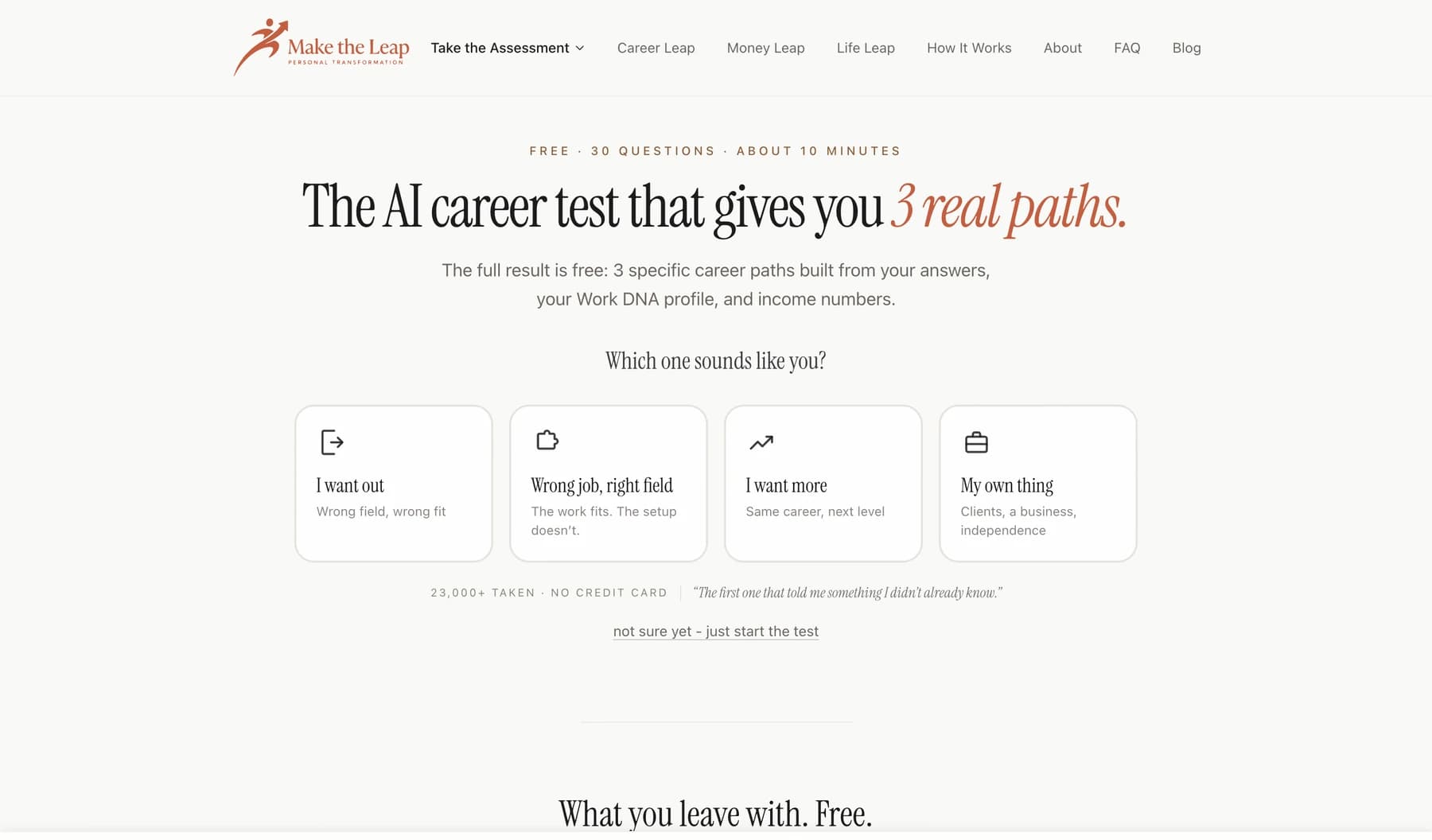
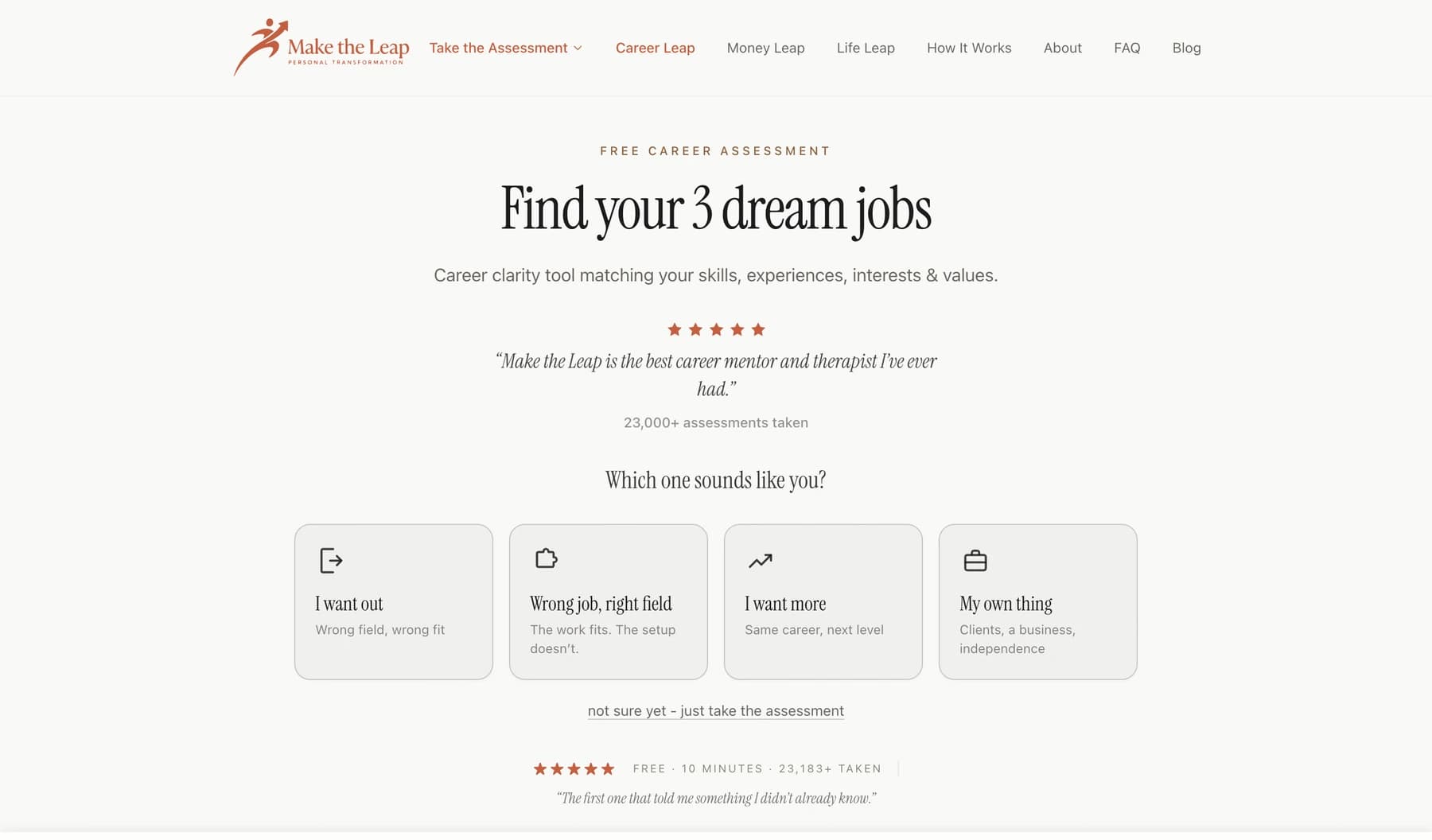
Make the Leap is a free AI career assessment that works from your written answers instead of scored checkboxes. In about 10 minutes (roughly 30 questions, several of them open text the AI genuinely reads), it returns three named career paths with income ranges, a Work DNA profile of what actually energizes you, and the resistance pattern that has kept you circling.
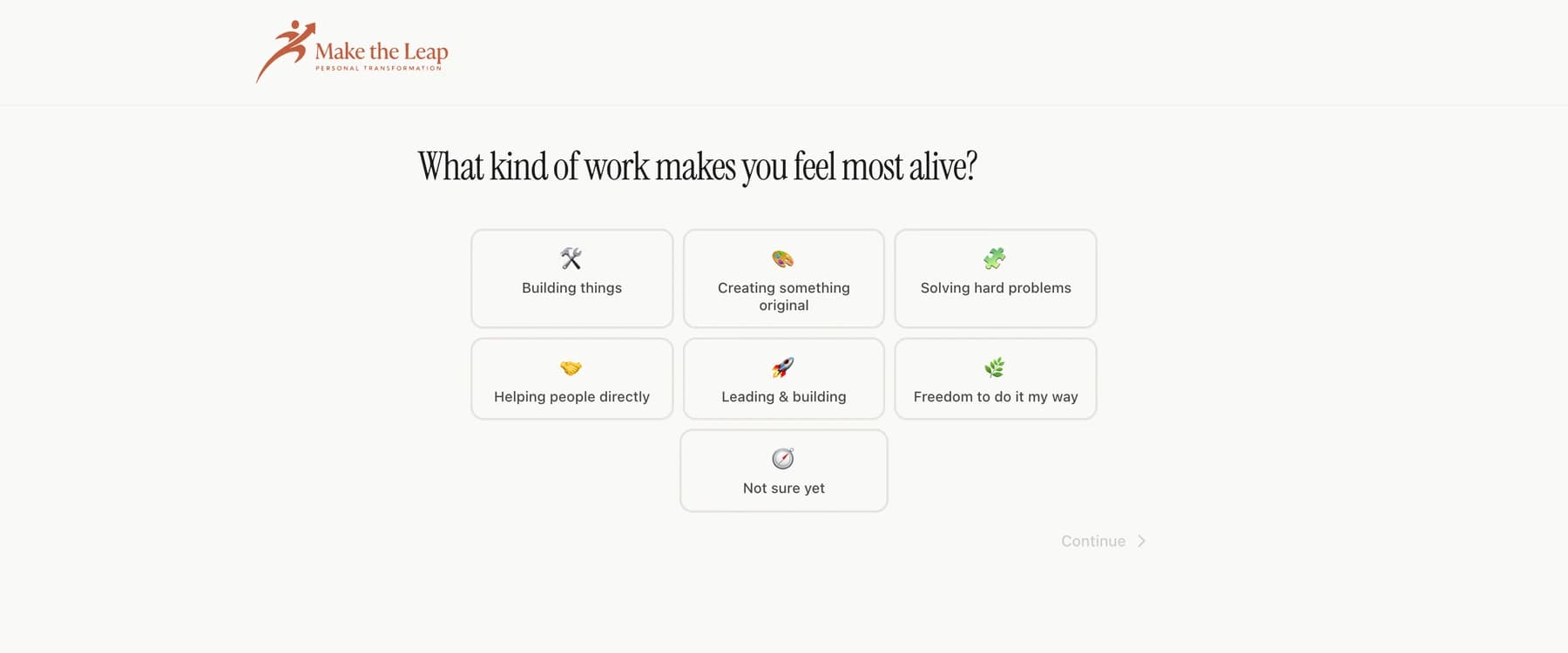
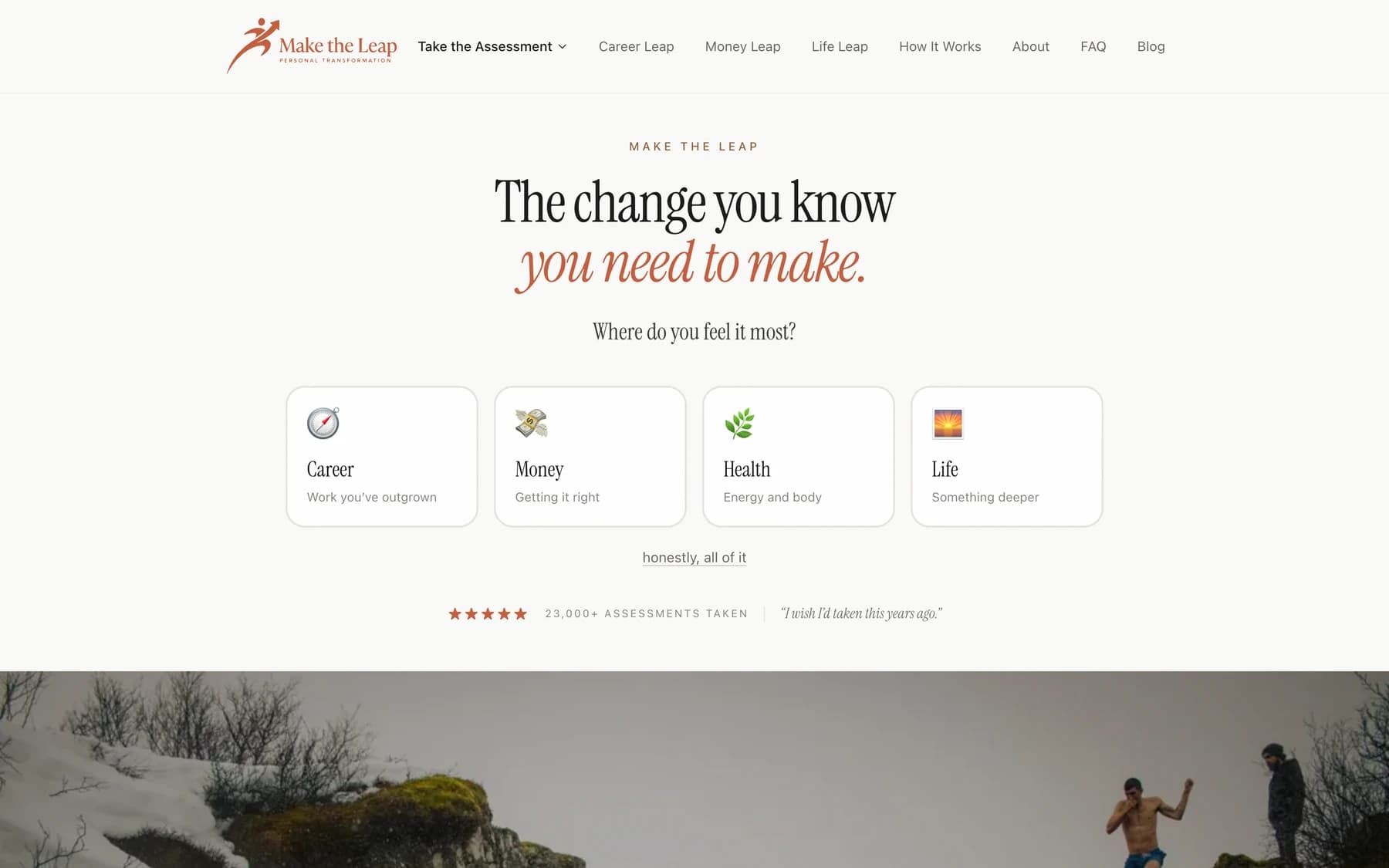
What it does well. The free tier is the complete product: full results, no card, no account, and two free messages with an AI coach that has already read your assessment. The output is unusually specific. Instead of "you are an INFJ, consider helping professions," you get three actual directions with honest income numbers checked against the constraints you stated. When answers are ambiguous, it asks one or two clarifying questions before generating results rather than guessing. And it publishes its aggregate data openly: 23,000+ assessments taken as of August 2026, with findings like 49% of takers naming burnout and 63% being 15+ years into their careers, all on the public research page.
Where it falls short. It is newer than everything else on this list, which is why automated scam-checker sites hedge on the domain despite clean scans. It is a decision tool, not a clinically validated psychometric instrument, and its own research page says so. And while the free result is complete, the execution depth (a week-by-week plan) sits in the paid tiers.
Price (as of Aug 2026). Free in full. Optional one-time deep dives: $29 Career Brief, $79 Career Roadmap. 14-day money-back guarantee on both.
Best for: mid-career professionals who need specific, income-realistic directions rather than a personality label. I wrote a full transparent review, including its limitations and who should skip it, and a separate comparison of the free AI career quiz market.
2. Truity: best validated instrument
Truity is the serious version of the personality-test approach. Its Career Personality Profiler runs on the Big Five and Holland Code models, the two frameworks with actual scientific lineage in vocational psychology, and around 94 questions in roughly 15 minutes.
What it does well. The test itself is free and the methodology is legitimate rather than pop-psych. The paid report is a one-time $29, not a subscription, and Truity backs it with a 60-day money-back guarantee, the most generous refund policy in this roundup. The expanded report is substantial: about 36 pages with several dozen matched careers.
Where it falls short. The consistent criticism across independent reviews, and the core finding of Make the Leap's first-hand review, is that Truity is interest-true but situation-blind. Ninety-four multiple-choice clicks about preferences cannot know that you are 15 years into a career, supporting a family, or unable to take a pay cut, so the matches read true while the "what now" stays unanswered. Reviewers also note the paid report reads like polished category descriptions rather than a plan.
Price (as of Aug 2026). Test free; full report $29 one-time, 60-day guarantee.
Best for: people who want a validated, research-grounded read on their interests and personality before layering context on top.
3. CareerExplorer (Sokanu): best career database
CareerExplorer has been iterating since 2012 and pairs a Big Five and Holland Code lineage with one of the largest consumer career databases anywhere. It is the assessment most often linked from university career-advising pages.
What it does well. The core test is free (with an account), the reports are well organized, and the sheer breadth of its career data is unmatched in this list. If you want to explore hundreds of scored matches with detailed occupation profiles, this is the deepest catalog.
Where it falls short. Time and follow-through. Independent reviewers consistently report 60 to 90 minutes of real test time against an advertised 30, and the most common criticism is walking away with a long ranked list of matches and no clearer sense of what to do next. Reviewers also note the matching can be overly literal, with a mentioned hobby visibly steering results. Make the Leap's published analysis reaches the same conclusion, and to be fair notes it has not taken the full test end-to-end, which is more disclosure than most roundups offer.
Price (as of Aug 2026). Core test and matches free with registration; premium upsells exist.
Best for: patient explorers who enjoy working through a big dataset and do not mind translating a ranked list into a plan themselves.
4. O*NET Interest Profiler: best free baseline
The O*NET Interest Profiler is the US Department of Labor's free RIASEC interest assessment, wired into the O*NET occupational database: real wage data, growth outlooks, and skill requirements for nearly every job in the economy.
What it does well. Completely free, no upsell, no email capture, and backed by decades of public occupational research. The interest codes it produces are the same framework career counselors use, and the occupation pages it links to contain the most authoritative wage and outlook data you can get.
Where it falls short. There is no AI and no personalization beyond your interest codes. It will tell you that you are "Investigative-Artistic" and hand you a list of occupations; it will not read your constraints, your experience, or your reasons for leaving. The presentation is also unmistakably government-issue. It is a reference tool, not a guide.
Price. Free, period.
Best for: students and early-career people (it is what I recommend instead of Make the Leap for that group), and anyone who wants an authoritative, zero-cost starting point.
5. APT AI: the viral one, with caveats
APT AI is the career test you have probably seen in your feed. It wraps a personality and aptitude test into an AI "career mentor" subscription, with resume tools attached.
What it does well. The marketing is honest about one thing: it is engaging. Public reviewers praise the resume revamp features and find the mentor chat genuinely useful for interview prep and job-search tactics. As an execution-side coaching bundle, plenty of users are happy.
Where it falls short. Structure, mostly. Make the Leap's first-hand review found the test is a front-end onto a subscription product, with results sitting behind an email wall and payment. The recurring themes in its public Trustpilot reviews are having to pay before seeing results, and a strict no-refund policy on purchases, which APT's own terms confirm. Some reviewers also report the suggestions felt like a general chatbot with a career skin. Weigh those against the positive reviews and decide what you are optimizing for.
Price (as of Aug 2026). Subscription model; purchases largely non-refundable per their terms. Check current pricing on their site, as it changes.
Best for: people who want an ongoing coaching-app experience and are comfortable with a subscription and its refund terms.
6. ChatGPT (with structured prompts): best DIY option
You do not need a dedicated tool to think about your career with AI. I use ChatGPT daily across three businesses, and with a well-structured prompt sequence it can do real discovery work: pattern-mining your history, generating options, pressure-testing a direction against your finances.
What it does well. Unmatched flexibility, a generous free tier, and no ceiling on follow-up questions. If you already pay for ChatGPT Plus ($20/month), the marginal cost of career exploration is zero. Make the Leap publishes a free set of career-change prompts that gives you a structured sequence to run, which fixes the biggest DIY problem (not knowing what to ask).
Where it falls short. Structure and honesty. A blank chat window has no methodology: it will happily mirror your framing, agree with your bad ideas, and produce different answers on different days. You also have to feed it all your context manually, every time. Ruby W., a Make the Leap user, described the gap on the public reviews page: "I've used chatGPT and Gemini and neither have given me the ideas and the actual helpful responses that this has." A general model is a brilliant thinking partner and a mediocre assessment.
Price (as of Aug 2026). Free tier; Plus $20/month.
Best for: self-directed people who enjoy driving the process and want infinite follow-up depth.
7. Teal: best for executing the change
Teal is not a direction tool at all, and that is why it earns the last slot: once you know where you are going, the work becomes applications, and Teal is the best-reviewed way to run that pipeline. (I have not run a full job search through Teal myself; the read here comes from its own site and aggregated public reviews.)
What it does well. A kanban-style job tracker (saved, applied, interview, offer) with notes, contacts, and reminders; a resume builder with per-job tailoring; and ATS-style matching feedback before you apply. The free tier is genuinely usable long-term for the tracker, and public reception is strong: over 650,000 members and a "Great" 4.1 Trustpilot rating as of August 2026. Reviewers consistently praise how uncluttered it feels.
Where it falls short. The good AI is paywalled: the free plan caps AI resume bullets, summaries, and cover-letter credits at token amounts, and heavy users end up on Teal+ at roughly $29/month, which is expensive next to one-time-fee resume tools. It does not auto-submit applications, and it will never tell you which career to pursue.
Price (as of Aug 2026). Tracker free; Teal+ around $29/month, billed in shorter increments. Check their pricing page.
Best for: the execution phase, after a direction tool (or your own clarity) has answered the "what" question.
The comparison table
| Tool | Best for | Free tier | Paid (as of Aug 2026) | Evidence |
|---|---|---|---|---|
| Make the Leap | Finding your direction | Complete result: 3 named paths with income ranges | $29 Brief / $79 Roadmap, one-time, 14-day guarantee | Built and used firsthand |
| Truity | Validated instrument | Full 94-question test | $29 report, one-time, 60-day guarantee | Full 94-question run, documented |
| CareerExplorer | Deep career database | Core test with account | Premium upsells | Verified, not fully tested |
| O*NET Profiler | Free baseline | Everything | None | Public tool, reviewed |
| APT AI | Coaching-app experience | Results paywalled | Subscription, largely non-refundable | Full run documented + public reviews |
| ChatGPT | DIY exploration | Generous free tier | Plus $20/mo | Used daily |
| Teal | Application execution | Job tracker | Teal+ ~$29/mo | Verified via public reviews |
How I would actually combine them
Career change is a sequence, not a single tool. The stack I would run in 2026:
- Direction (week 1): take Make the Leap's free assessment for three specific, income-checked paths. If you want a second, methodology-different opinion, run Truity's free test and compare where they agree.
- Validation (weeks 2-3): pressure-test the leading path in ChatGPT with the structured prompt sequence, and pull the hard wage and outlook numbers from O*NET's occupation pages.
- Execution (week 4 onward): set up Teal's tracker, then work through my AI resume builders guide and resume, cover letter, and interview prompts as applications start moving.
One number worth sitting with as you start: in Make the Leap's Career Change Deliberation Study (n=22,252), 94.9% of people had been thinking about their change for months or years before acting, and the single biggest group had been deliberating for one to two years. The tools above will not decide for you. What they do is convert an endless "maybe" into a comparable set of options, and that is usually what finally breaks the loop.
The bottom line
I built Make the Leap, so take this recommendation with that context. But for experienced professionals trying to change careers without throwing away 10 to 25 years of career capital, it is the tool I would start with. Most of the alternatives on this list specialize in personality typing, occupational matching, resumes, or applications. Only one was built for the actual mid-career decision. (Want the deep dive before you decide? My complete Make the Leap review covers the product screen by screen, including its limitations and who should skip it.)
The assessment matches your skills, experiences, interests, and values, then hands you three personalized career paths with real income ranges. It takes about 10 minutes, the full result is free, and there is no card and no account. If one of those paths makes you feel something, you will know exactly what to do next. If none of them do, you have lost ten minutes and gained a clearer picture of what you don't want.
Take the free career assessment →
FAQ
What is the best AI career tool in 2026?
It depends on your stage. For finding a direction, Make the Leap gives the most specific free result (three named paths with income ranges, read from your own words). For a validated instrument, Truity. For a free authoritative baseline, O*NET. For executing applications once the direction is set, Teal.
Can AI actually help me change careers?
It cannot make the decision for you, but it collapses the research phase from months to days. The real bottleneck is deliberation: 94.9% of 22,252 assessment takers had been thinking about a change for months or years before acting. Tools that turn restlessness into specific, comparable options are what break that loop.
Are AI career tests accurate?
Treat all of them as decision tools, not oracles. Validated instruments (Truity, CareerExplorer's lineage) are consistent but situation-blind. AI-driven tools (Make the Leap) read your actual context but are not clinically validated psychometric instruments, and the honest ones say so. In every case, the quality of your input drives the quality of the output.
Which of these are actually free?
O*NET: entirely free. Make the Leap: the full assessment and complete results are free; only the deep-dive plans cost money. Truity: the test is free, the report is $29. CareerExplorer: core test free with an account. Teal: the tracker is free, the AI features are paid. APT AI is the exception, with results behind its subscription.

Written by Jon Miksis
Founder of AI Hustle Guy, Make the Leap, and Europe Flight Club, and the travel blogger behind Global Viewpoint (9+ years, 73 countries). He brings 9+ years of coaching and mentorship experience and has facilitated 23 transformation retreats across four continents. Every AI tool and prompt on this site gets tested on his own businesses first.
Get my free AI prompt pack
Join 300+ founders, creators, and professionals. I’ll send you my go-to AI tools and copy-paste prompts that save hours every week. No spam.