The 8 Best AI Health & Wellness Tools in 2026 (Personalized, Not Hype)
By Jonathan Miksis · August 27, 2026 · 9 min read
The wellness industry has a data problem: everything gets measured, nothing gets prioritized.
You can wear a ring that grades your sleep, a band that scores your recovery, and an app that logs every meal, and still have no answer to the only question that matters: what should I fix first?
The stakes are not small. CDC surveillance data has long found that roughly one in three US adults does not get enough sleep, and in Make the Leap's research dataset of 23,183 working adults considering a change, 49% name burnout as a current pain. Plenty of measurement is happening. The fixing is what lags.
That question is how this list is organized. I run my businesses and my own health experiments on AI tools daily, and this guide covers the eight that actually earn their place in 2026, with honest pricing, limitations, and a clear note on which facts come from first-hand use.
Two things before the list. First, the standard that matters most here: none of this is medical advice, and none of these are medical devices. They are consumer wellness tools, good at patterns and priorities, useless at diagnosis. Anything involving symptoms, medications, or treatment belongs with a clinician. Second, disclosure: the #1 pick is my own product. I built Make the Leap. Same rules as every roundup on this site: held to the same criteria, sources linked, nobody paid for placement, and none of the health-tool links here are affiliate links.
The short answer: if you already know your weak spot, skip to the tool that targets it (tracking, training, behavior change, mental wellness). If you don't, start with the free Health Leap assessment, because finding the right target is the step every other tool assumes you have already done.
1. Health Leap: best personalized starting point
Evidence: built and used firsthand. Free in full; optional paid deep dives.
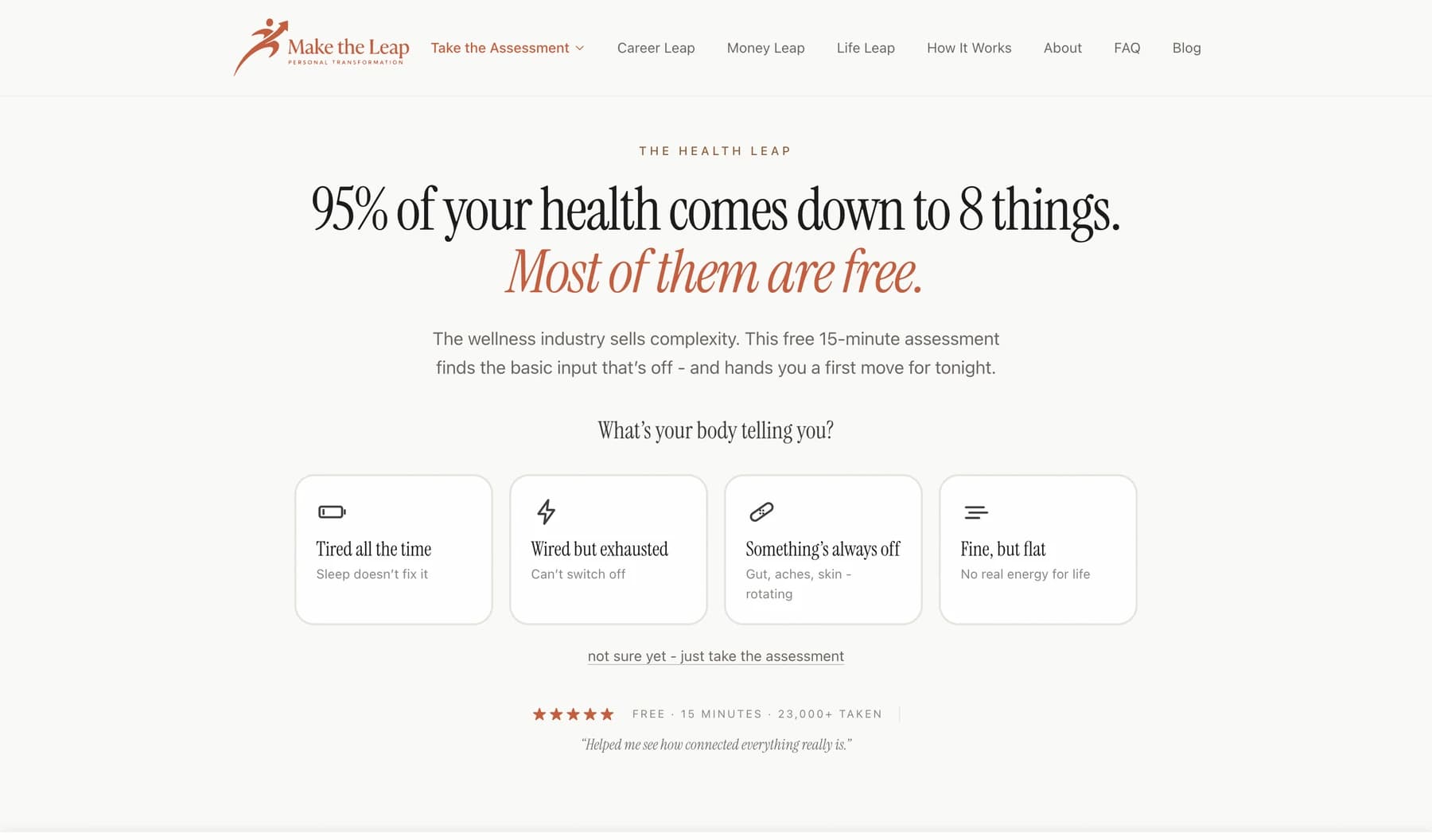
Health Leap is a free 15-minute holistic assessment built on a premise the wellness industry hates: 95% of your health comes down to 8 things, and most of them are free. Thoughts, air, water, light, grounding, relationships, food, and movement, plus sleep. The assessment reads your answers, written in your own words rather than scored checkboxes, and identifies the one input costing you the most right now, with a first move you can make tonight.
Why it earns #1: it is the only tool on this list that answers the prioritization question. The result is fully personalized: two people get two different limiting pillars, because the analysis is built from what each person actually wrote, not a template with a name pasted in. And the free tier is the complete result, no card, no account. If you want depth, the full Health Map is $39 and the 4-week Protocol is $99, both one-time, with a 14-day money-back guarantee and an AI Health Coach that has already read your full map (2 free messages included).
Limitations, honestly: it is a reflection and prioritization tool, not a clinically validated instrument, and its own pages say so. It will not track anything passively; it tells you where to point the trackers.
Best for: the "tired all the time," "wired but exhausted," and "fine, but flat" crowd who suspect the answer is basic but can't see which basic.
2. Oura Ring: best passive tracking
Evidence: public data and Oura's own site, as of August 2026.
Oura remains the most livable wearable: a ring you forget you're wearing that grades sleep, readiness, and activity, now with an AI advisor that turns the data into daily guidance.
Why it's good: best-in-class sleep staging for a consumer device, screens-off form factor, and years of trend data if you stay with it. Limitations: the ring costs $399 to $499 and the useful features sit behind a $5.99/month membership, so the real cost is the ring plus about $70 a year. And like every tracker, it describes; it does not prioritize. Best for: people whose limiting pillar is sleep and who want the measurement to prove it.
3. Whoop: best for training recovery
Evidence: public data and Whoop's own site, as of August 2026.
Whoop is the recovery-and-strain specialist: a screenless band with a coaching layer that tells you how hard to push today based on how you slept and recovered.
Why it's good: the strain/recovery model genuinely changes behavior for people who train hard, and the subscription includes the hardware. Limitations: subscription-only (roughly $199 to $359 a year across its tiers since the 2025 restructure), and overkill if you don't train seriously. Best for: athletes and serious exercisers whose question is "how hard today?"
4. Fitbod: best AI training plan
Evidence: public data and Fitbod's own site, as of August 2026.
Fitbod generates strength workouts that adapt to your equipment, recovery, and progress, and it is the closest an app gets to a decent programming coach.
Why it's good: the progression logic is real; it remembers what you lifted and balances muscle groups over time. Limitations: it programs training, nothing else; pairing it with nothing upstream means optimizing exercise while the actual constraint is sleep or food. Paid plans start around $7 a month. Best for: people whose limiting pillar is movement and who need structure, not motivation.
5. Noom: best structured behavior change
Evidence: public data and Noom's own site, as of August 2026.
Noom wraps weight and habit change in psychology-first daily lessons with AI-assisted coaching.
Why it's good: it takes the behavior side seriously, which most calorie apps skip entirely, and the daily-lesson format builds actual understanding. Limitations: it is a committed program, not a casual app; pricing varies by program length, so check their current plans, and the coaching quality varies. Best for: people who know the what (food habits) and need scaffolding for the how.
6. Headspace: best mental wellness entry point
Evidence: public data and Headspace's own site, as of August 2026.
Headspace pairs its meditation library with Ebb, an AI companion for reflection, on a subscription that runs roughly $70 a year.
Why it's good: the lowest-friction on-ramp to a daily mental-wellness practice, with production quality nothing else matches. Limitations, stated plainly: an AI companion is not therapy and should never be sold as therapy. For clinical concerns, see a licensed professional (and if you are one, my AI tools for therapists guide covers that side). Best for: the thoughts pillar, at the everyday-maintenance level.
7. Bearable: best symptom and habit correlation
Evidence: public data and Bearable's own site, as of August 2026.
Bearable is the indie gem of this list: a tracker built for connecting the dots, logging symptoms, mood, sleep, meds, and habits, then surfacing correlations over time.
Why it's good: genuinely loved in chronic-condition communities because it answers "what makes me feel worse?" with your own data, and the free tier is usable. Limitations: correlations are hypotheses, not conclusions; it takes weeks of honest logging to say anything; the interface rewards diligence. Best for: people managing a recurring condition who want evidence to bring to appointments.
8. ChatGPT: best DIY health analyst (with guardrails)
Evidence: daily first-hand use.
A frontier model is a genuinely useful health research assistant: explaining lab terminology, turning your tracking exports into readable patterns, and preparing sharper questions for your doctor.
The guardrails are the point: it is not a medical professional, consumer versions carry no health-privacy agreement for what you paste in, and it can be confidently wrong, so treat every output as a starting question, not an answer. Used that way, it is free and excellent. I keep a set of AI prompts for sleep and health tracking that shows exactly what this looks like in practice.
The comparison at a glance
Competitor facts from each product's own site and public data, as of August 2026.
| Tool | Best for | What's free | Paid (as of Aug 2026) | Evidence |
|---|---|---|---|---|
| Health Leap | Finding what to fix first | Complete personalized result | $39 Health Map / $99 Protocol, one-time, 14-day guarantee | Built and used firsthand |
| Oura Ring | Passive sleep tracking | Nothing (hardware required) | $399+ ring plus $5.99/mo | Public data |
| Whoop | Training recovery | Nothing | ~$199-359/yr, hardware included | Public data |
| Fitbod | AI workout programming | Limited trial | From ~$7/mo | Public data |
| Noom | Behavior change | Trial | Varies by program | Public data |
| Headspace | Everyday mental wellness | Limited | ~$70/yr | Public data |
| Bearable | Symptom correlations | Usable free tier | Inexpensive premium | Public data |
| ChatGPT | DIY research assistant | Generous free tier | Plus $20/mo | Daily use |
The stack I'd actually run
Health tools fail when they are bought in the wrong order. The sequence that works:
- Diagnose (this week, free): take the Health Leap assessment and get your limiting pillar. Fifteen minutes, no card, and it converts "I should be healthier" into one specific target.
- Measure (if the pillar needs proof): sleep pillar, Oura; movement and training, Whoop or Fitbod; a recurring symptom, Bearable.
- Change (one habit at a time): food habits, Noom; thoughts, Headspace; and ChatGPT throughout as the free analyst that turns your data into questions worth asking a professional.
Most people run this backwards: they buy the $400 ring first and hope the dashboard tells them what matters. The dashboard never does. Diagnosis is free; start there.
FAQ
What is the best AI health tool in 2026?
Depends on your stage. Don't know what to fix first: Health Leap, a free 15-minute personalized assessment that finds your limiting input across 8 pillars plus sleep. Tracking sleep: Oura. Training: Whoop or Fitbod. Structured behavior change: Noom. Trackers tell you what happened; the assessment tells you where to start.
Are AI health tools safe and accurate?
Treat them all as consumer wellness tools, not medical devices. They are good at patterns, habits, and prioritization; none of them diagnose or treat anything, and the trustworthy ones say so plainly. Symptoms, medications, and medical decisions belong with a clinician.
Can ChatGPT give health advice?
It can explain concepts, organize your data, and sharpen the questions you bring to a doctor, and that is where it should stop. No consumer AI chat carries a health-privacy agreement for what you paste in, and confident wrongness is a real failure mode. Research assistant: yes. Diagnosis: never.
What AI health tools are actually free?
Health Leap's full personalized result is free. Bearable and Fitbod have real free tiers. Oura needs the ring plus a membership; Whoop is subscription-only. Check what the result costs, not just the download.
What is a holistic health assessment?
One that looks across your basic inputs (sleep, food, movement, light, relationships, stress, environment) to find the constraint limiting everything else, rather than measuring one metric deeply. It answers "what should I fix first?" where a tracker answers "what happened last night?"

Written by Jon Miksis
Founder of AI Hustle Guy, Make the Leap, and Europe Flight Club, and the travel blogger behind Global Viewpoint (9+ years, 73 countries). He brings 9+ years of coaching and mentorship experience and has facilitated 23 transformation retreats across four continents. Every AI tool and prompt on this site gets tested on his own businesses first.
Get my free AI prompt pack
Join 300+ founders, creators, and professionals. I’ll send you my go-to AI tools and copy-paste prompts that save hours every week. No spam.