Claude Fable 5.1 vs Fable 5, GPT-5.6, Gemini & Grok: Which AI Model Should You Actually Use?
By Jonathan Miksis · Updated September 1, 2026 · 27 min read
Anthropic just released Claude Fable 5.1 and Mythos 5.1.
And after digging through the benchmarks, pricing, technical documentation and early testing, I think the most important takeaway is being missed.
Fable 5.1 is not simply a slightly smarter Fable 5.
Its biggest improvements show up when AI stops answering questions and starts doing actual work.
Think debugging a complicated codebase. Investigating why something broke. Researching across dozens of sources. Working through a messy business problem. Using tools repeatedly. Building something across multiple files. Staying on a problem long enough to find the actual cause.
That distinction matters to me because I use AI across several very different businesses.
I use Claude Code heavily when building and improving Make the Leap. I use AI for SEO, content and research across Global Viewpoint. And with AI Hustle Guy, I constantly compare tools for research, writing, strategy and real business workflows.
I've also learned not to become loyal to one model.
Sometimes I'll let Claude attack a problem first and use ChatGPT to challenge the conclusion. Sometimes I want the deepest reasoning available. Other times, paying for frontier intelligence would be ridiculous.
So rather than asking, "What's the smartest AI model?", I think the better question is: what model gives me the best result for the work I'm actually doing? (That routing mindset is the backbone of my full ChatGPT vs Claude vs Gemini comparison, and Fable 5.1 changes the answer in some interesting ways.)
The short answer: which AI model should you use?
If you don't want to read the full comparison, here's where I'd start.
| What you're doing | Model I'd try first |
|---|---|
| Extremely difficult coding or debugging | Claude Fable 5.1 |
| Long autonomous Claude Code task | Claude Fable 5.1 |
| Complicated business investigation | Claude Fable 5.1 |
| Deep multi-source research | Fable 5.1 or GPT-5.6 Sol |
| High-quality everyday professional work | Claude Opus 5 or GPT-5.6 Sol |
| Everyday coding | Claude Sonnet 5 or Opus 5 |
| High-volume workflows | Claude Sonnet 5 |
| Writing and content strategy | GPT-5.6 Sol, Fable 5.1 or Opus 5 |
| Huge multimodal inputs | Gemini 3.1 Pro |
| Difficult science or engineering reasoning | Gemini 3.1 Pro with Deep Think, or Fable 5.1 |
| Visual and interactive app creation | Grok 4.6 deserves a test |
| Maximum-value work where failure is expensive | Fable 5.1 |
| Basic emails, summaries and rewrites | Do not waste Fable 5.1 on this |
Notice that Fable 5.1 does not win every row.
That's intentional.
Even Anthropic's own documentation says developers should start with Claude Opus 5 for most workloads and move to Fable 5.1 for demanding reasoning and long-horizon agentic work.
That is probably the single most important thing to understand about this release.
Claude Fable 5.1 vs Fable 5: what actually changed?
Fable 5 launched as Anthropic's highest-end broadly available model for demanding reasoning and long-horizon agentic work.
Fable 5.1 keeps the same basic technical envelope.
Both have:
- A 1 million-token context window
- Up to 128,000 output tokens
- Adaptive thinking
- $10 per million standard input tokens
- $50 per million output tokens
So this is not a bigger-context story.
The improvement is what the model does with the compute it already has.
Here's the comparison that matters.
| Area | Fable 5 | Fable 5.1 | Why I care |
|---|---|---|---|
| Scientific research, Terminal-Bench-Science | 24.7% | 52.6% | Much stronger complex investigation |
| Agentic coding, Terminal-Bench 4.0 | 42.0% | 55.8% | Better long coding workflows |
| Knowledge work, GDPval-AA v2 | 1723 | 1853 | Better professional reasoning |
| Business workflows, AutomationBench | 17.1% | 31.4% | More reliable multi-step work |
| Computer use, OSWorld strict | 36.1% | 41.7% | Better operating software |
| Humanity's Last Exam, no tools | 57.8% | 60.9% | Better difficult reasoning |
| Cache read price | Higher | $0.25/M tokens | Large recurring contexts become cheaper |
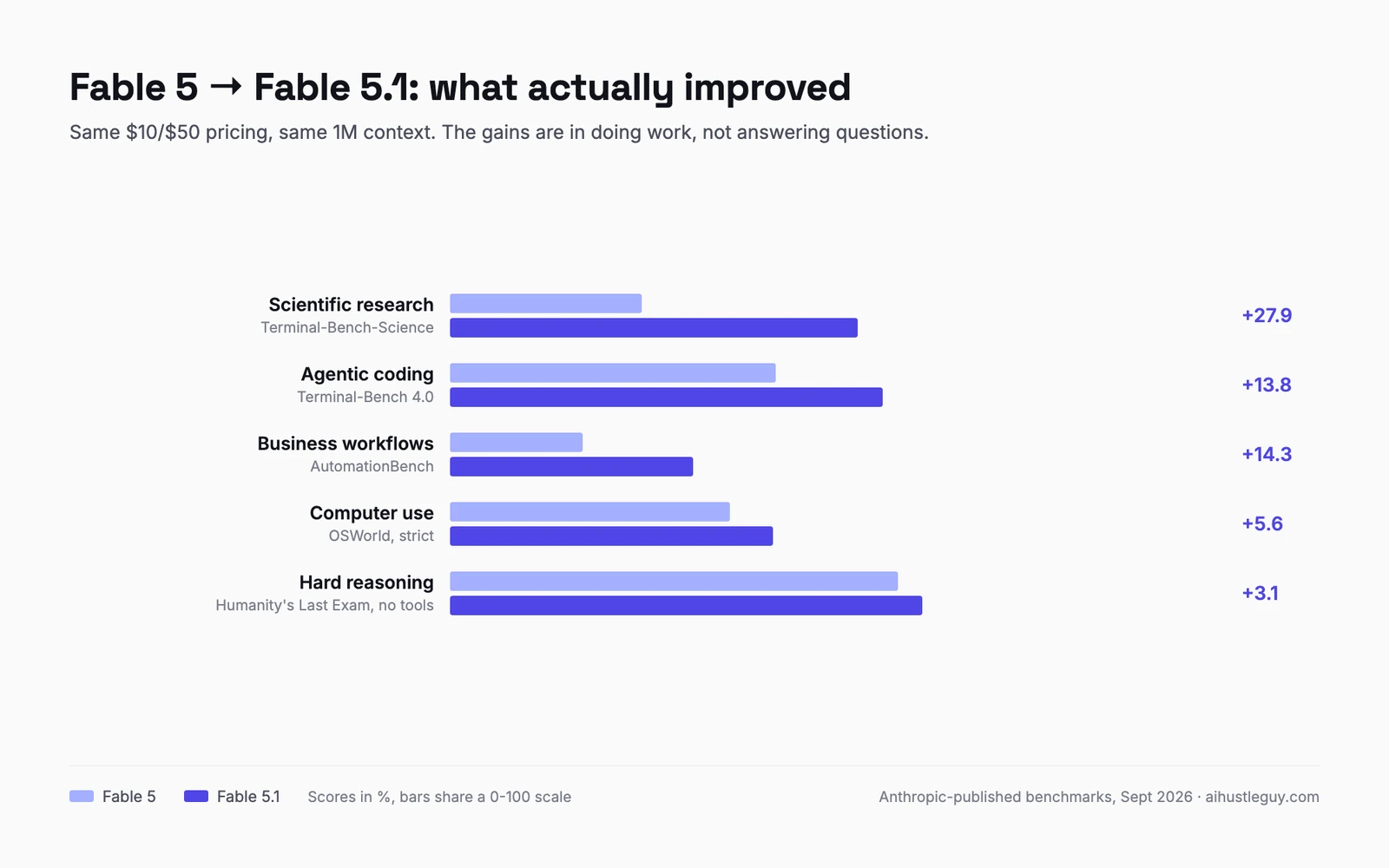
These are Anthropic's own evaluations, not independent testing. I would not treat them as the final verdict.
Still, several improvements are large enough to pay attention to. Anthropic reports that Fable 5.1 more than doubled Fable 5's score on its Terminal-Bench-Science setup and nearly doubled performance on AutomationBench.
Independent Fable 5.1 evaluations were still limited when I wrote this because the model had just launched. Artificial Analysis had previously ranked Fable 5 among the leading frontier models, although it was expensive and relatively slow.
I'll care more about Fable 5.1's independent results once evaluators have had time to test it.
But benchmarks are only half the story. Here's what the changes could actually mean for your work.
1. Fable 5.1 appears much better at staying with hard problems
This is probably the biggest upgrade.
A lot of current AI feels brilliant for the first few steps of a task.
Then things deteriorate.
The model forgets a constraint. It stops investigating. It accepts its first plausible explanation. It fixes a symptom instead of the cause. Or it leaves you with something that looks finished but isn't.
Fable 5.1 appears specifically designed to improve this.
Anthropic describes stronger performance on long-running agentic coding, multi-step research and extended professional workflows. Early-access testers also reported better performance across long, unattended tasks.
What this means in real life
Imagine asking AI: "Why did my conversion rate fall?"
A weaker workflow might inspect Google Analytics, notice traffic changed and give you five possible explanations.
A stronger agentic workflow could:
- Compare dates.
- Segment traffic sources.
- Inspect landing pages.
- Look for technical changes.
- Compare devices.
- Inspect conversion events.
- Check checkout behavior.
- Identify when the change began.
- Connect it to a deployment.
- Verify the hypothesis before answering.
That is an entirely different category of usefulness.
For entrepreneurs, the valuable AI isn't necessarily the one that gives the cleverest answer.
It's the one that keeps investigating after the obvious answer stops being good enough.
2. Fable 5.1 seems more interested in root causes
This one caught my attention immediately.
Anthropic specifically says Fable 5.1 is better at avoiding shortcuts and fixing underlying causes rather than settling for lower-quality work.
One Anthropic launch example came from investment firm Millennium. They reportedly had an extremely rare software crash that had gone unexplained for years. Fable 5 had missed it. Fable 5.1 analyzed an outside software library, connected it to the crash data and traced the issue back to a bug inside that library.
I wouldn't assume every developer will suddenly solve four-year-old bugs.
But the underlying behavior matters well beyond programming.
For a marketer
Instead of: "Your Facebook ads aren't converting because the creative is weak."
You want: "The creative isn't the main problem. Click-through rate held steady. The conversion decline starts after the landing page change on August 17."
For an entrepreneur
Instead of: "Sales are down. Try a promotion."
You want the model to determine whether the problem is traffic, positioning, conversion rate, retention, pricing or something else.
For an employee
Instead of: "You need better time management."
You might discover that 11 hours of your week are disappearing into meetings created by one broken approval process.
That's the difference between generating advice and diagnosing systems.
3. Fable 5.1 could be significantly better for Claude Code
This is probably where I'm personally most interested in the release.
I've increasingly been using Claude Code for real development work rather than treating AI as a glorified coding autocomplete.
I might have it inspect a codebase, diagnose something, research an issue, implement changes, run tests, audit the result and challenge its own work.
That's precisely where Fable 5.1's improvements should matter.
Anthropic reports a jump from 42.0% to 55.8% on Terminal-Bench 4.0 compared with Fable 5. It also reports 73.4% on CursorBench 3.2 at maximum effort.
More interestingly, testers repeatedly highlighted its ability to work across complicated systems.
Plaid reported an evaluation involving more than eight services across three codebases. Fable 5.1 reportedly mapped the workflow accurately down to functions, tables and database rows.
Browserbase reported an 82% completion rate on its hardest browser-agent benchmark, versus 57% for Fable 5.
Red Hat reported stronger root-cause analysis across broken builds.
Where I'd personally use it
I wouldn't switch every Claude Code session to Fable 5.1.
If I'm making a simple copy change, editing metadata or touching one straightforward component, that's wasteful.
But suppose I'm working on Make the Leap and the problem involves multiple routes, API calls, database behavior, AI generation, fallback logic, user-facing state, analytics, latency and edge cases, all at once.
That's exactly the type of task where I'd rather pay more for a model that can hold the whole system in its head.
The harder it is for a human to explain the entire problem in one sentence, the more interesting Fable 5.1 becomes.
4. Medium-effort Fable 5.1 might be more important than max-effort Fable 5.1
This is one of the least flashy but most useful parts of the release.
Anthropic gives Fable 5.1 five effort levels: Low, Medium, High, xHigh and Max.
More effort generally means more reasoning, but also more tokens, money and time.
Here's the important part.
Anthropic says Fable 5.1 at Medium effort roughly matches Fable 5 at lower cost. Its gains over Fable 5 become larger at the higher effort settings.
That changes how I would use the model.
My rule would be:
Low: extraction, classification and simpler jobs.
Medium: serious everyday professional work.
High: difficult analysis and meaningful coding.
xHigh: genuinely hard problems.
Max: problems where being wrong or missing something is expensive.
Do not automatically move every task to Max because it sounds better. You'll waste time and tokens.
Anthropic actually recommends testing effort levels against your own work because the labels don't represent identical amounts of reasoning between Fable 5 and Fable 5.1.
That's an important nuance.
Medium Fable 5.1 may sometimes be a better business decision than maximum Fable 5.
5. Fable 5.1 can be cheaper than Fable 5 without actually having cheaper token prices
This part is easy to misunderstand.
Fable 5.1 still costs $10 per million input tokens and $50 per million output tokens. Those headline prices did not fall.
What Anthropic dramatically reduced is cache-read pricing.
Fable 5.1 cache reads cost $0.25 per million tokens, a 75% reduction.
Anthropic estimates this produces roughly 25% lower costs for typical token-billed workloads, and potentially up to about 45% lower costs for highly agentic workloads.
Why?
Imagine Claude is working inside a giant codebase. It doesn't need to completely reprocess every instruction, file and piece of context from scratch each time it takes another step. Cached context becomes disproportionately important.
The longer and more agentic the workflow, the more that savings can matter.
This matters far more for AI products than normal chat
If you ask Claude, "Rewrite this email," prompt caching barely matters.
But suppose your AI system repeatedly references a 50-page company knowledge base, customer history, project documentation, product instructions, a large codebase, a long conversation, or dozens of connected files.
Now the economics change.
This is exactly why evaluating models only on their headline token price is becoming increasingly misleading.
6. Fable 5.1 looks substantially better for business workflows
One benchmark I found particularly interesting was AutomationBench.
Fable 5 scored 17.1%. Fable 5.1 scored 31.4%. Opus 5 scored 26.9%. GPT-5.6 Sol scored 19.6% in Anthropic's reported setup.
Again, these are Anthropic's numbers.
But this is the type of benchmark entrepreneurs should pay attention to, because AI's next major productivity jump isn't another chatbot that writes slightly prettier paragraphs.
It's AI that can reliably complete workflows.
Imagine saying:
"Review every customer complaint from the past quarter, group them by cause, compare those causes with refund data, identify which problem costs us the most money and create a prioritized improvement plan."
Or: "Audit these 300 pages, identify everything that is outdated, prioritize changes by potential revenue impact and create implementation tickets."
Or: "Analyze our customer funnel, find the biggest leak, inspect the relevant pages and recommend the three experiments most worth running."
That's where long-horizon reasoning becomes economically interesting.
The output isn't a paragraph. The output is completed cognitive work.
7. Research could be one of Fable 5.1's biggest strengths
Anthropic's most dramatic benchmark improvement was on Terminal-Bench-Science. Fable 5 scored 24.7%. Fable 5.1 scored 52.6%.
I'm careful with scientific benchmarks because most entrepreneurs are not designing proteins.
But sophisticated research uses many of the same underlying abilities: forming hypotheses, locating relevant evidence, working across sources, detecting contradictions, testing assumptions, revising conclusions, and keeping track of long reasoning chains.
That's useful almost everywhere.
Market research
Don't ask, "What are the trends in my industry?"
Give the model a real research mandate. Ask it to identify competing explanations, prioritize primary sources, quantify uncertainty and tell you what evidence would disprove its conclusion.
Competitive research
Have it map pricing, positioning, product differences, customer complaints and changes over time.
SEO research
Instead of asking for keywords, let the model inspect search intent, SERPs, your content, competitors, internal data and where the evidence actually points.
That's much closer to how I like using AI myself.
I don't want an AI that sounds certain. I want one that earns the conclusion.
An important Fable 5.1 research caveat
Anthropic notes that at Low effort, Fable 5.1 is less likely to trigger search and retrieval tools.
That's important. If current information matters, don't assume that lowering effort simply gives you the same research process with less thinking. You may need to explicitly tell the model to search.
For example: "Search current primary sources before answering. Do not answer this from memory."
I use variations of that instruction constantly because it prevents one of AI's most dangerous habits: giving you a polished answer to a question it should have researched.
8. Fable 5.1 might be a better writer than Fable 5
This surprised me because Anthropic is marketing Fable primarily around coding, knowledge work and research.
Early testers repeatedly mentioned writing quality.
Canva reported preferring Fable 5.1's writing to Fable 5 during blind tests, particularly for understandable output and following writing guidance. Glean also reported its evaluators preferred Fable 5.1 roughly two-to-one over Fable 5 across everyday knowledge, research, drafting and artifact work.
That is not independent evidence. But it is enough that I'd test it.
Where this could matter
For content creators, the real test isn't, "Can Claude write a blog post?" Almost every frontier model can.
The harder questions are: Can it preserve a distinctive voice? Can it follow 15 writing constraints simultaneously? Can it stay specific? Can it avoid filler? Can it synthesize research without flattening everything? Can it separate fact from inference? Can it revise one section without making the rest worse?
Those are much tougher tests.
That's also why I often prefer having one model produce something and another critique it. Model disagreement can be useful.
Content creators should know one Fable 5.1 weakness
Buried inside Anthropic's prompting documentation is something I think publishers should know.
Anthropic says Fable 5.1 can be more likely than Fable 5 to reproduce retrieved source passages without clearly marking them as quotations.
That's not a trivial issue.
If you're using AI for research-heavy publishing, I would explicitly instruct it to paraphrase sources, clearly mark direct quotations, distinguish source claims from analysis, preserve source attribution, and avoid reproducing source language unnecessarily.
I would also verify important claims yourself. A smarter model does not remove the need for claims discipline.
9. Fable 5.1 is more interesting for long autonomous work
This may ultimately be the biggest shift.
Several early testers described workflows where Fable 5.1 ran for hours without losing the thread.
MongoDB described it researching multiple services, designing a prototype and then working unattended through implementation. Ramp reported a 38-hour machine-learning workflow involving diagnosis and parallel experiments. Shopify highlighted better continuity across long unattended work.
These are hand-picked launch examples. Still, they point toward something important.
Most people today use AI synchronously. Prompt. Answer. Prompt. Answer.
But increasingly, I'm interested in: objective → investigate → act → verify → continue → return when done.
If that workflow becomes dependable, it changes the economics of knowledge work far more than another 10% improvement in chatbot answers.
10. Fable 5.1 has better safeguards, but Mythos 5.1 probably doesn't matter to you
Anthropic launched two names: Claude Fable 5.1 and Claude Mythos 5.1.
For most people, you can ignore the second one.
Anthropic says Fable 5.1 and Mythos 5.1 are the same underlying model with different safeguard systems. Fable 5.1 is broadly available. Mythos 5.1 is restricted through trusted-access programs intended particularly for advanced cybersecurity and life-sciences work.
So if you're asking, "Should I use Fable 5.1 or Mythos 5.1?", my answer is simple: use Fable 5.1. If you genuinely need Mythos, you probably already operate in one of the specialized environments where access is relevant.
Anthropic also says its updated cyber safeguards produce roughly 60% fewer interventions per Claude Code session than the previous Fable 5 safeguards. That could remove some friction for legitimate developers working on security-related code.
Claude Fable 5.1 vs Opus 5: don't automatically pick Fable
This is where I'd ignore the hype.
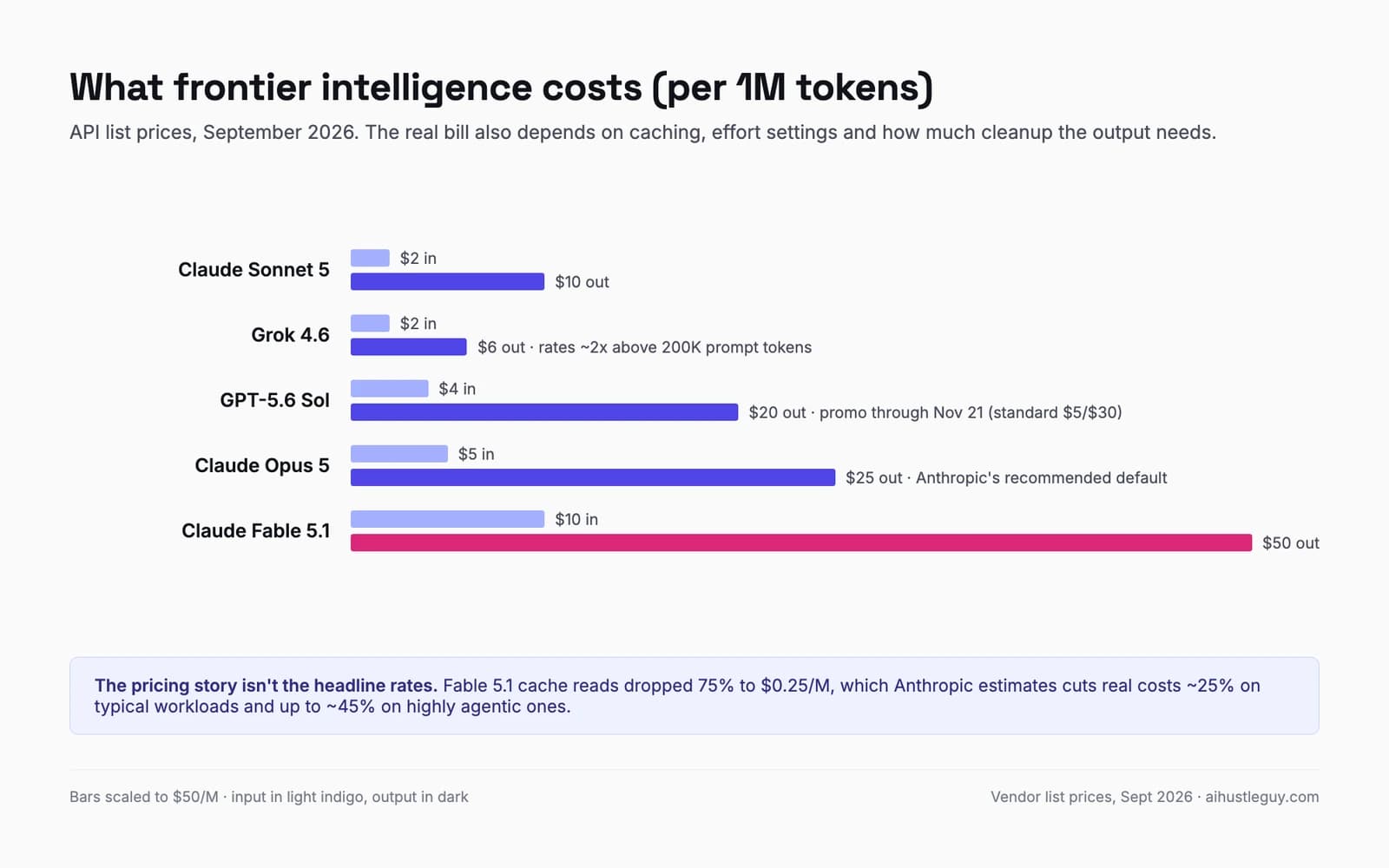
Claude Opus 5 costs $5 per million input tokens and $25 per million output tokens. That's half Fable 5.1's standard rates. It also has the same 1-million-token context window and 128K maximum output.
Anthropic specifically recommends Opus 5 as the starting model for most workloads. I'd follow that advice. (My earlier deep dive on Claude Opus for founders covers the Opus side of the family.)
Use Opus 5 when:
You need excellent analysis, coding or professional work, but the task isn't unusually difficult.
Move to Fable 5.1 when:
The problem has resisted other models. There are many dependent steps. The model needs to work autonomously. The task spans large systems or datasets. Finding the wrong answer would be expensive. The model needs to investigate rather than merely respond.
That's how I think about premium models generally.
Don't ask whether Fable is smarter. Ask whether your problem is hard enough to benefit from the extra intelligence.
Claude Fable 5.1 vs Sonnet 5
Sonnet 5 is even cheaper: $2 per million input tokens and $10 per million output tokens.
Anthropic positions it as the best balance of speed and intelligence. That makes Sonnet attractive for everyday coding, content processing, customer support, routine analysis, extraction, workflow automation, and high-volume business tasks.
Fable costs five times as much per standard input token.
That means your default question shouldn't be, "Can Fable do this better?" It probably can.
Ask: "Would Fable do this enough better to justify paying for it?"
Those are very different questions.
Claude Fable 5.1 vs GPT-5.6 Sol
This is probably the comparison most people will care about outside the Claude ecosystem.
OpenAI currently positions GPT-5.6 Sol as its flagship model for complex professional work. It has roughly a 1.05-million-token context window, up to 128K output tokens and configurable reasoning from none through max. Current API pricing is $4 per million input tokens and $20 per million output tokens, a promotional cut from the standard $5/$30 rates that OpenAI has committed to through at least November 21, 2026.
So on headline token rates, GPT-5.6 Sol is considerably cheaper than Fable 5.1.
Anthropic's own Fable 5.1 benchmarks show impressive wins against Sol on several tasks, but I would not use Anthropic testing alone to declare an overall winner.
Independent evaluations make the broader lesson clear: performance changes significantly depending on reasoning effort, benchmark and workload. Artificial Analysis, for example, currently finds GPT-5.6 Sol and Grok 4.6 extremely competitive at the frontier under some settings.
My approach
For a difficult Claude Code problem, I'd reach for Fable 5.1 first.
For broad professional reasoning, research, writing or an independent second opinion, I'd absolutely keep GPT-5.6 Sol in the rotation. (I compared the two families job by job in Fable 5 vs GPT-5.6 Sol; the workload logic there still holds for 5.1.)
I already like using models against each other. If Claude produces an important conclusion, I may ask ChatGPT: "Assume this analysis is wrong. Find the weakest assumptions, missing evidence and alternative explanations."
That's often more valuable than asking the same model to admire its own homework.
Fable 5.1 vs Gemini 3.1 Pro (and the Unreleased 3.5 Pro)
Gemini remains especially interesting when the work is heavily multimodal.
Google's current Pro model, Gemini 3.1 Pro, pairs a 1-million-token context window with text, image, audio and video inputs in a single call. Gemini 3.1 Pro, announced at I/O in May 2026 with a 2-million-token window, has not shipped as of September 2026; only Gemini 3.5 Flash is generally available, so the comparison below is against the Pro model you can actually use today.
That's a real differentiator.
If I wanted to analyze hours of video, screenshots, documents, audio, transcripts, or large mixed-media source sets, Gemini would be high on my test list.
Gemini 3.1 Pro's Deep Think mode, available on the Google AI Ultra plan, is more interesting for difficult science, mathematics and engineering problems. Google reports especially strong performance across scientific and academic evaluations.
My simple distinction
Fable 5.1: difficult autonomous knowledge work.
Gemini 3.1 Pro: multimodal understanding and specialized scientific reasoning.
There will obviously be overlap. That's why actual workload testing beats model fandom.
Fable 5.1 vs Grok 4.6
Grok has become harder to dismiss.
xAI released Grok 4.6 in August 2026 with a particular emphasis on long-running agents and interactive visual work. It can research, work across codebases and turn ideas into applications and artifacts.
Grok 4.6 also has compelling API economics. xAI lists $2 per million input tokens, $0.50 per million cached input tokens and $6 per million output tokens with a 500K context window. One caveat worth knowing for agentic use: those rates roughly double once a request exceeds 200K prompt tokens, so context management matters more than the headline price suggests.
Artificial Analysis has found high-effort Grok 4.6 extremely competitive with GPT-5.6 Sol on its Intelligence Index.
Would I suddenly replace Claude Code with Grok? No.
But for agentic workflows, interactive apps and visually ambitious prototypes, I would test it rather than dismiss it based on older versions of Grok.
My AI model stack in 2026
The biggest mistake I see people making is trying to identify the AI model they should use.
I don't think that model exists.
I increasingly think about AI the way I think about hiring specialists. You wouldn't ask, "Who is the best employee?" You'd ask, "Best at what?"
My own stack looks more like this.
For difficult software work: Claude
Claude Code has become one of the tools I lean on most heavily for building and improving Make the Leap. For ordinary work, Sonnet or Opus can make sense. For messy, system-wide problems where Claude needs to investigate, reason, implement and verify, Fable 5.1 becomes extremely interesting.
For a second brain and independent challenge: ChatGPT
I regularly want another model looking at the same problem. This is especially valuable for research, strategy, claims and complicated decisions. If Claude says A, I don't always want Claude explaining why Claude is right. Sometimes I want GPT-5.6 Sol trying to prove A wrong.
For multimodal mountains of information: Gemini
Google's ability to work across text, image, audio and video makes Gemini especially interesting when the source material isn't just text. I'd choose based on the information I'm feeding the model, not merely benchmark intelligence.
For cheap, repeated work: smaller models
If you're processing thousands of items, don't automatically send everything through a frontier model. Use the cheapest model that clears your quality threshold. Then escalate difficult cases.
For truly hard problems: Fable 5.1
That's the new slot.
Fable 5.1 is the model I'd reach for when I find myself saying: "I don't just need an answer. I need you to figure this out."
That distinction matters.
👉 Want to know what this stack should look like for your business? Start with my free AI audit: you tell me how you work, and I tell you which workflows AI should take off your plate first, and which tier of model each one actually needs. Free, no call, and it's how most of my done-for-you setup clients start.
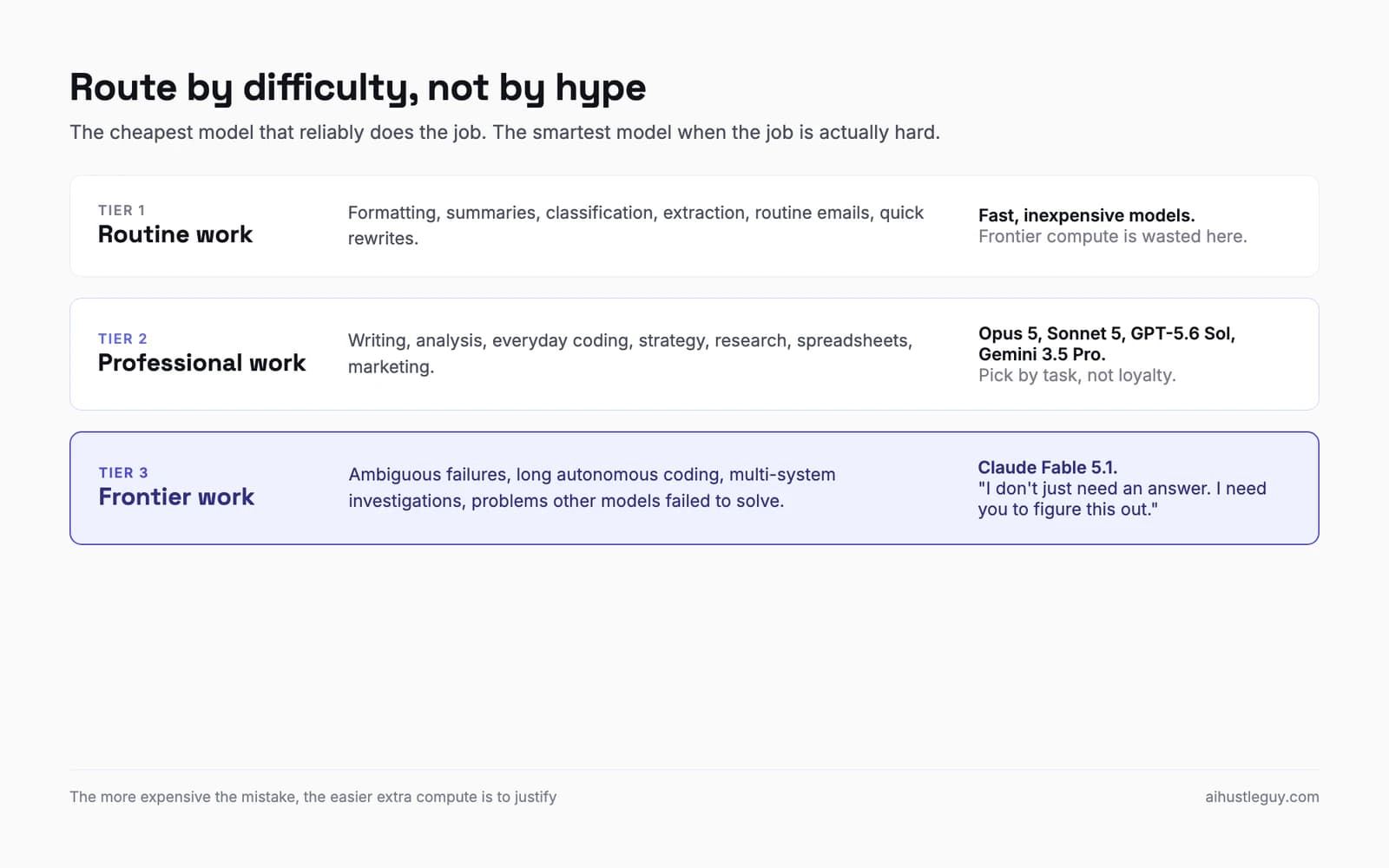
The easiest framework for choosing an AI model
I divide work into three categories. (If you want the career side of this, model routing is one of the AI skills that actually pay right now.)
Tier 1: routine work
Formatting, summaries, basic rewriting, classification, simple extraction, routine emails, straightforward brainstorming.
Do not waste Fable 5.1 here. Use a fast, inexpensive model.
Tier 2: professional work
Writing, analysis, coding, strategy, research, spreadsheets, marketing, business planning.
This is where models such as Opus 5, Sonnet 5, GPT-5.6 Sol and Gemini 3.1 Pro compete. Pick based on the task.
Tier 3: frontier work
Ambiguous technical failures, long autonomous coding tasks, extremely complicated research, multi-system investigations, high-value strategic decisions, long agentic workflows, problems other models failed to solve.
This is where Fable 5.1 earns its keep.
The more expensive the mistake, the easier it becomes to justify spending more compute.
Should you switch from Fable 5 to Fable 5.1?
If you already use Fable 5, I would test 5.1 immediately.
The baseline context and standard token pricing are unchanged, while Anthropic reports substantial capability gains and much cheaper cache reads.
But don't simply replace Fable 5 High with Fable 5.1 High and call the migration finished.
Test Fable 5.1 Medium against your existing Fable 5 workflow first. Anthropic explicitly says Medium Fable 5.1 can roughly match Fable 5 at lower cost.
That could be the real upgrade. Not more intelligence for more money, but similar intelligence for less money, or considerably more intelligence when the problem warrants it.
Should normal Claude users care about Fable 5.1?
Yes, but perhaps less than the benchmark charts suggest.
If most of your Claude usage is emails, brainstorming, summarizing, rewriting and basic questions, Fable 5.1 probably isn't going to transform your life. You're already operating below the capability ceiling of cheaper models.
But if you're increasingly giving AI projects instead of prompts, pay attention. That is where I think this release matters.
The AI industry is gradually moving from "give me an answer" to "own this problem."
Fable 5.1 looks like another meaningful step in that direction.
What I'd test before moving serious work to Fable 5.1
Benchmarks are useful. Your own work is better.
If I'm evaluating a new model, I care about eight things:
- Did it get the answer right?
- Did it find what other models missed?
- Did it follow every important instruction?
- Did it verify its own work?
- How much did I have to correct afterward?
- How long did the task take?
- How much did it cost?
- Would I trust it with less supervision next time?
Number five may be the most underrated AI benchmark in business: how much human cleanup was required?
A model that costs twice as much but cuts my editing or debugging time by 80% can be cheaper. A cheap model that creates subtle errors can be incredibly expensive.
Cost per token isn't the same thing as cost per successful outcome.
My take on Claude Fable 5.1
Fable 5.1 looks like a meaningful upgrade over Fable 5.
The most interesting gains are not flashy chatbot features. They're deeper. It appears better at staying on difficult problems, completing long agentic workflows, diagnosing root causes, working across complicated codebases, conducting multi-stage research, handling business workflows, using additional reasoning effectively, and producing strong results at lower effort settings.
And because cache reads are dramatically cheaper, some of the workflows that benefit most from Fable 5.1 also benefit most from its new economics.
Still, I would not use it for everything. Anthropic doesn't recommend that either.
For most professional work, Opus 5, Sonnet 5, GPT-5.6 Sol, Gemini and other models remain extremely capable. Fable 5.1 makes the most sense when the value of getting the problem right outweighs the cost of using more intelligence.
And that leads to the rule I use increasingly with AI:
Use the cheapest model that reliably does the job. Use the smartest model when the job is actually hard.
The frontier-model race changes every few months. That principle probably won't.
FAQ
Is Claude Fable 5.1 worth upgrading to from Fable 5?
If you use Fable 5 for demanding work, test 5.1 immediately: same $10/$50 pricing, cache reads down 75%, and Anthropic reports medium-effort 5.1 roughly matches Fable 5 at lower cost. Test Fable 5.1 Medium against your current workflow before reaching for the higher effort settings.
What is the difference between Fable 5.1 and Mythos 5.1?
Same underlying model, different safeguard systems. Fable 5.1 is broadly available; Mythos 5.1 is restricted to trusted-access programs for specialized cybersecurity and life-sciences work. For almost everyone: use Fable 5.1.
Is Fable 5.1 better than GPT-5.6 Sol?
Task-dependent. Anthropic's benchmarks show Fable 5.1 winning on agentic coding and long-horizon work; Sol is considerably cheaper ($4/$20 on current promotional pricing vs $10/$50) and excellent for broad professional reasoning. I reach for Fable 5.1 on hard Claude Code problems and keep Sol in rotation for research, writing, and second opinions.
How much does Fable 5.1 cost?
$10 per million input tokens, $50 per million output, unchanged from Fable 5. The real news: cache reads at $0.25 per million (a 75% cut), which Anthropic says lowers real costs ~25% for typical workloads and up to ~45% for highly agentic ones.
Sources and methodology
I based this comparison primarily on Anthropic's September 1, 2026 Fable 5.1 and Mythos 5.1 release announcement, Claude's Fable 5.1 technical documentation, Anthropic's Fable 5 documentation and Anthropic's Fable 5.1 prompting guidance.
For competitor specifications and positioning, I referenced OpenAI's GPT-5.6 Sol documentation, Google DeepMind's Gemini 3.1 Pro materials and xAI's Grok 4.6 announcement. I also referenced Artificial Analysis for independent context around existing frontier models. Because Fable 5.1 launched the day this article was written, comprehensive independent testing of the new model was not yet available.
Where I cite Fable 5.1 benchmark results or launch-partner experiences, those results should be understood as Anthropic-published evidence unless otherwise stated. I'll update my recommendations as stronger independent evidence becomes available.
Keep going
- ChatGPT vs Claude vs Gemini: The Best AI Model for Your Business in 2026
- Claude Fable 5 vs GPT-5.6 Sol: Who Wins Each Job
- Claude Opus for Founders: Agent Teams, 1M Context & Adaptive Thinking
- Claude Cowork: The AI Assistant for People Who Don't Code
- AI Skills That Actually Pay in 2026 (Ranked by Evidence)

Written by Jon Miksis
Founder of AI Hustle Guy, Make the Leap, and Europe Flight Club, and the travel blogger behind Global Viewpoint (9+ years, 73 countries). He brings 9+ years of coaching and mentorship experience and has facilitated 23 transformation retreats across four continents. Every AI tool and prompt on this site gets tested on his own businesses first.
Get my free AI prompt pack
Join 300+ founders, creators, and professionals. I’ll send you my go-to AI tools and copy-paste prompts that save hours every week. No spam.