ChatGPT vs Claude vs Gemini: The Best AI Model for Your Business in 2026
By Jonathan Miksis · Updated September 3, 2026 · 10 min read
Last updated July 2026. I keep this guide current as new models ship, so it reflects the actual state of play, not last year's leaderboard.
Everyone wants a single answer to "what's the best AI model?" Here's the honest one: there isn't one, and chasing it is how founders waste money.
I run multiple businesses on AI as core infrastructure, content, SEO, strategy, and automation, and I pay for ChatGPT, Claude, and Gemini at the same time. Not because I'm indecisive. Because each one is genuinely the best tool for a different job, and knowing which to reach for is worth more than any benchmark score.
This is the founder's comparison: less leaderboard drama, more "which one should I actually open for this task." Let me break it down.
The quick verdict
If you want the short version, here's who wins what in 2026:
| If you want... | Reach for | Why |
|---|---|---|
| The safest single pick for a non-technical owner | ChatGPT | Biggest ecosystem, most integrations, flexible new pricing tiers |
| Best long-form writing and editing | Claude | Most natural voice, handles huge documents without drifting |
| Best research and anything in Google | Gemini | Searches live, 2M-token context, native in Gmail/Docs |
| Hard reasoning, analysis, and coding | Claude or ChatGPT (Sol tier) | Both lead here; pick by ecosystem |
| Best value for high-volume automation | ChatGPT (Terra) or Gemini Flash | Cheapest capable models for bulk work |
| Best free option | Gemini | Most generous free tier for everyday use |
Now the detail, and the part most comparisons skip: how to combine them so you stop overpaying.
ChatGPT vs Claude vs Gemini at a glance
| ChatGPT (OpenAI) | Claude (Anthropic) | Gemini (Google) | |
|---|---|---|---|
| Current top model | GPT-5.6 (Sol / Terra / Luna) | Claude Fable 5.1 + Opus 5 | Gemini 3.1 Pro (3.5 Pro announced, unreleased) |
| Best at | Ecosystem, custom GPTs, everyday range | Long documents, writing, agent workflows | Live research, Google apps, huge context |
| Context window | Large | 1M tokens (Opus) | 2M tokens (largest) |
| Standout 2026 feature | Sol/Terra/Luna cost tiers | Agent teams + Cowork for non-coders | Deep Think mode + native video (Veo) |
| Weak spot | Can feel generic on nuanced writing | Smaller plugin/app ecosystem | Consumer version lags the frontier model |
| Standard plan | Plus, $20/mo | Pro, $20/mo | AI Pro, $19.99/mo |
| Free tier | Yes | Yes | Yes (most generous) |
Every one of these ships new versions constantly, so treat the specifics as a July 2026 snapshot. What rarely changes is what each is fundamentally good at, which is what should drive your choice.
ChatGPT (GPT-5.6): the flexible default
ChatGPT is still the one most people should start with, simply because it's everywhere. The integrations, the custom GPTs, the sheer ubiquity mean whatever you're trying to do, there's a path.
The big 2026 change is that GPT-5.6 split into three tiers, Sol (flagship, for hard problems), Terra (balanced, for high-volume business work at about half the old cost), and Luna (fast and cheap for routine tasks). For a business owner, that's genuinely useful: you stop paying flagship prices for assistant-level work. I broke down exactly which tier to use for which task in my full GPT-5.6 guide for business owners.
- Best for: general-purpose work, custom GPTs, anyone who wants one tool that does a bit of everything.
- Pricing: free tier; Plus $20/mo; Pro $200/mo; Go $8/mo. API tiers run from $1/$6 (Luna) up to $4/$20 (Sol, on promotional pricing through at least Nov 21, 2026; standard $5/$30) per million tokens.
- The catch: on genuinely nuanced writing, it can still read a touch generic compared to Claude.
Claude (Fable 5 & Opus 4.8): the writer and the operator
Claude is what I reach for when the work is writing-heavy, long, or needs real judgment. Anthropic's current lineup, the new Fable 5 flagship plus Opus 4.8, leads on the things founders actually do: drafting that sounds human, analyzing long documents without losing the thread, and increasingly, delegating whole projects.
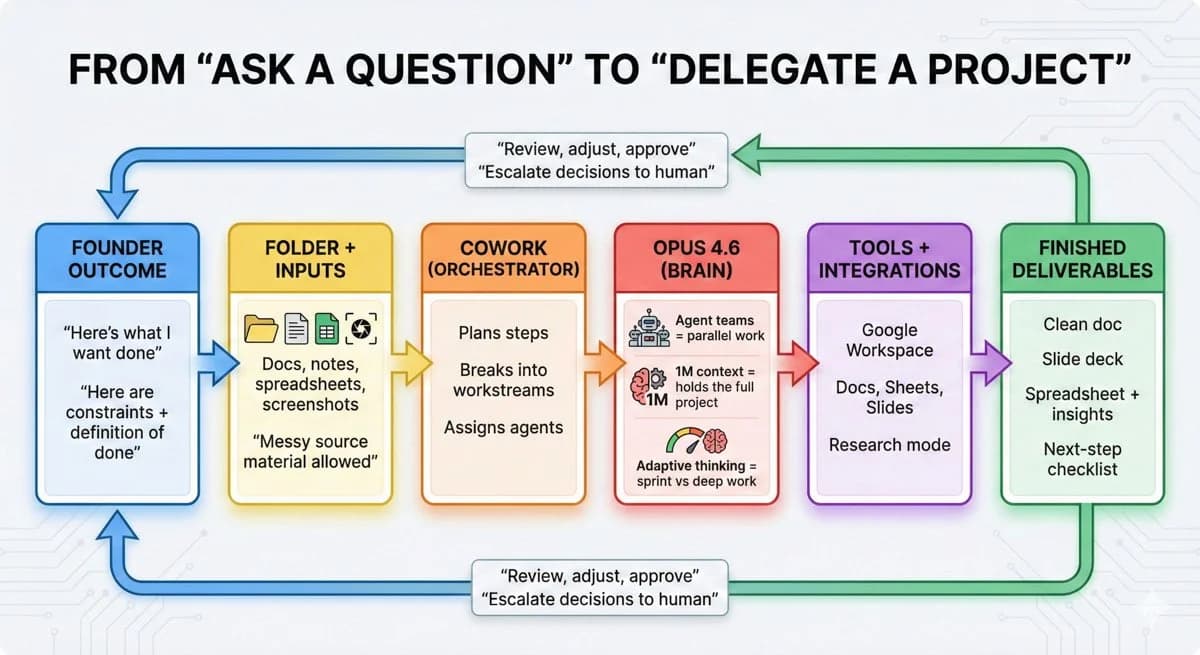
Two things make Claude special for non-technical business owners right now. First, the 1M-token context window means you can hand it your entire business, plan, financials, customer research, and it holds all of it in one conversation. Second, Cowork (Anthropic's tool for non-developers) lets you point Claude at a folder and delegate a project, not just ask a question. I covered what this means for running a company in my Claude Opus for founders breakdown.
- Best for: long-form content, editing, contracts and document analysis, and multi-step "delegate the whole thing" work.
- Pricing: free tier; Pro $20/mo; Max $100/mo and $200/mo. Fable 5.1 (the current flagship) runs $10/$50 per million tokens on the API, with cache reads cut 75% in the September 2026 update. My full Fable 5.1 breakdown covers when it's worth it.
- The catch: fewer third-party plugins and integrations than ChatGPT, so it's less of a "connect everything" hub.
Gemini (3.5 Pro): the researcher with Google's home advantage
Gemini's edge is that it lives inside Google. If your work runs through Gmail, Docs, Sheets, and Search, Gemini is already where your information is, and it can reason over live search results in a way the others can't match.
Gemini 3.1 Pro carries a 1-million-token context window, a Deep Think mode for hard reasoning on the Ultra plan, and native video generation in the Gemini app (now through Gemini Omni). Gemini 3.5 Pro, announced with a 2-million-token window, has not shipped as of September 2026. For research, live data, and anything multimodal, it's my first stop. The prompting is a little different from the others, which is why I wrote a whole Gemini prompt engineering guide and a set of Gemini prompts for content creation.
- Best for: research, live information, Google Workspace users, huge documents, and video generation.
- Pricing: genuinely useful free tier; AI Plus $7.99/mo; AI Pro $19.99/mo; AI Ultra $249.99/mo.
- The catch: the consumer app sometimes trails the newest frontier model, and the ecosystem pull is strongest if you're already all-in on Google.
Which AI should you use? A decision framework
Skip the "which is smartest" debate and match the tool to your actual work:
- You mostly write (content, emails, posts, copy): Claude first, ChatGPT second.
- You do a lot of research or live-data work: Gemini, hands down.
- You want one tool and you're non-technical: ChatGPT. It's the most forgiving on-ramp.
- You live in Google Workspace: Gemini, it's already in your inbox and docs.
- You run automations at volume and care about cost: ChatGPT's Terra tier or Gemini Flash.
- You want to delegate whole projects, not just prompts: Claude with Cowork.
- You're on a tight budget: start on Gemini's free tier, add one $20 plan when you outgrow it.
Most founders I work with land on two: a primary daily driver plus one specialist. My own default is Claude for creation and ChatGPT for range, with Gemini for research. The full stack I actually run is on my tools page.
Pricing: what each actually costs
The good news is that the three have converged. Here's the 2026 subscription picture:
| Plan level | ChatGPT | Claude | Gemini |
|---|---|---|---|
| Free | Yes | Yes | Yes (most generous) |
| Budget | Go, $8/mo | None | AI Plus, $7.99/mo |
| Standard | Plus, $20/mo | Pro, $20/mo | AI Pro, $19.99/mo |
| Power user | Pro, $200/mo | Max, $100 & $200/mo | AI Ultra, $249.99/mo |
For most business owners, one $20 plan is the right starting point, and the honest truth is you'll feel the difference between free and paid within a day of real work. If AI is replacing hours you'd otherwise pay a contractor or VA for, even the $100 to $200 power tiers pay for themselves fast.
The real answer: don't pick one, route the work
Here's the mental shift that saves the most time and money. Stop asking "which AI is best" and start asking "which AI, and now which tier, fits this specific job."
That's the actual 2026 skill. A founder who routes summarization to a cheap fast model, drafting to Claude, and hard analysis to a flagship tier will run circles (and spend less) than someone hammering every task through the single most expensive model they can find. The models are all excellent now. The edge is in how you deploy them.
If you want the exact prompts I use to get the best out of each one, they're in my free AI prompt pack. And if you'd rather have this built into a real system around your business, that's what my done-for-you AI plans are for.
Frequently asked questions
What is the best AI model in 2026? There's no single winner, and that's the honest answer. For most business owners, ChatGPT is the safest all-rounder, Claude is best for writing and long documents, and Gemini is best for research and Google-based work. The smart move is matching the model to the task rather than forcing everything through one.
ChatGPT vs Claude: which is better? For nuanced writing, editing, and long-document work, Claude usually wins, its output sounds more human and it holds huge context without drifting. For general range, integrations, and custom GPTs, ChatGPT wins. I use both daily and route work between them.
Is Gemini better than ChatGPT? For live research, anything inside Google Workspace, and the largest context window, yes, Gemini has the edge. For general-purpose use and ecosystem, ChatGPT is still ahead. They're strongest at different things.
What's the best free AI model? Gemini has the most generous free tier for everyday use, and both ChatGPT and Claude offer capable free plans too. Start free, and only upgrade to a $20 plan once you hit the limits on real work.
What's the best AI for writing? Claude, for most people. It produces the most natural first drafts and is the strongest at editing to match your voice. Feed it samples of your writing and it gets noticeably better. See my Claude prompts for content creation.
What's the best AI for coding? ChatGPT's Sol tier and Claude both lead here in 2026. For non-developers who want AI to build or automate things, Claude Code and Cowork are the most capable, while ChatGPT's Codex is the other major option.
Which AI has the biggest context window? Gemini 3.1 Pro and Claude Opus 5 both at 1 million tokens (Gemini 3.5 Pro, announced with 2 million, has not shipped as of September 2026). In plain terms, that's how much information the model can hold in one conversation, and it matters a lot for long documents and complex projects.
Do I actually need to pay for AI? For casual use, no, the free tiers are solid. For real business work, a single $20 plan pays for itself almost immediately in hours saved. I'd start there before considering the power-user tiers.
Keep going
- AI Skills That Actually Pay in 2026 (Ranked by Evidence)
- Claude Fable 5 vs GPT-5.6 Sol: Who Wins Each Job
- GPT-5.6 (Sol, Terra & Luna): What OpenAI's New Model Family Means for Your Business
- Claude Fable 5 vs Opus 4.8: What Founders Need to Know
- Claude Opus for Founders: Agent Teams, 1M Context & Adaptive Thinking
- Claude Cowork: The AI Assistant for People Who Don't Code
- Gemini Prompt Engineering: The Complete Free Guide
- The AI tools I actually use, every day

Written by Jon Miksis
Founder of AI Hustle Guy, Make the Leap, and Europe Flight Club, and the travel blogger behind Global Viewpoint (9+ years, 73 countries). He brings 9+ years of coaching and mentorship experience and has facilitated 23 transformation retreats across four continents. Every AI tool and prompt on this site gets tested on his own businesses first.
Get my free AI prompt pack
Join 300+ founders, creators, and professionals. I’ll send you my go-to AI tools and copy-paste prompts that save hours every week. No spam.