Gemini 4 Argon vs Claude Opus 5.5, Fable 5.1 and GPT-6 Astra: Which AI Model Should You Actually Use?
By Jonathan Miksis · October 13, 2026 · 32 min read
Google released Gemini 4 Argon today, October 13, 2026.
Not a preview, not a waitlist. It is in the Gemini app for Google AI Pro and AI Ultra subscribers, and it is live in the Gemini API for anyone on the paid tier.
After a day running Argon on my own workflows in the Gemini app, on the Google AI Pro plan, and inside Google's announcement, the model card, the pricing page and the independent leaderboards, here is my read.
Argon is the first Gemini release in a long time that belongs in the same conversation as the best models from Anthropic and OpenAI.
On Google's own scorecard it leads on knowledge work, finance, automation and long-context recall. On the independent Artificial Analysis index it ties GPT-6 Astra and Claude Fable 5.1 while costing a fraction of either to run.
It is not the best model at everything. Claude Opus 5.5 still sits at the top of the independent index and still wins terminal-style coding. GPT-6 Astra still wins computer use. And some of Argon's biggest numbers come from Google's own benchmarks, which I weigh accordingly.
That nuance matters to me because I don't use one model. I use Claude Code heavily when building Make the Leap. I use AI for SEO, research and content across Global Viewpoint. And with AI Hustle Guy I constantly compare tools on real work.
So the question I care about is not "is Gemini 4 Argon the smartest model?" It is: for the work you actually do, which model should you open first? That routing mindset is the backbone of my ChatGPT vs Claude vs Gemini comparison, and this release changes several of the answers.
How to read this article. Every benchmark score below was published by Google, Anthropic, OpenAI or Artificial Analysis, not measured by me, and I say which is which. The task-by-task calls combine those numbers with my first day of using Argon on real work and my longer experience with Claude, ChatGPT and the Gemini 3.x line. Argon is one day old, so treat its recommendations as a launch-day view that I will update as independent testing lands.
Jump to: the short answer · what Argon is · pricing · Google's benchmark table · the independent index · task by task · caveats · sources
The short answer: which AI model should you use?
If you only read one section, start here.
| What you're doing | Model I'd try first |
|---|---|
| Huge documents, long recordings, video | Gemini 4 Argon |
| Spreadsheets, finance and numbers-heavy analysis | Gemini 4 Argon, then Opus 5.5 as a check |
| Delegated "do this for me" tasks inside Google's apps | Gemini 4 Argon in the Gemini app |
| Hard coding and debugging in a terminal | Claude Opus 5.5 (or Sonnet 5.5 for routine work) |
| Giant code migrations and very long outputs | Gemini 4 Argon deserves a test |
| Computer-use agents that click through software | GPT-6 Astra |
| Deep research and strategy | Claude Opus 5.5, with Argon when the input is enormous |
| Everyday writing and content | Opus 5.5 or your current ChatGPT model, test Argon |
| The hardest reasoning problem you have | Opus 5.5 first, Fable 5.1 if it stalls |
| High-volume, cheap, repeated work | Haiku 5.5, GPT-6 Luna or Gemini Flash |
| Best frontier model for $20 a month | Google AI Pro or Claude Pro, not ChatGPT Plus |
Notice that Argon wins the rows where the input is big, the work is numbers-shaped, or the task gets delegated. It does not win the rows that made Claude my coding default. That split is the whole story.
What Gemini 4 Argon actually is
Google announced Argon on September 30, 2026 with a limited release to cybersecurity defenders through its Fairwind Program. On October 13 it opened to everyone else who pays. Here is what is confirmed on Google's own pages, checked on October 13, 2026.
- Where you get it. The Gemini app on the Google AI Pro ($19.99 a month) and AI Ultra (from $99.99 a month) plans. Developers get it on the paid tier of the Gemini API in Google AI Studio, Android Studio and Google Cloud, under the model ID
gemini-4-argon. It is not on the Free or AI Plus consumer plans. Argon inside Antigravity, Google's agentic coding product, and inside AI Studio is an AI Ultra entitlement, not part of AI Pro. - Context window. A unified window of 1,048,576 tokens shared between input and output. That phrasing is deliberate: a 700,000-token input leaves roughly 300,000 for thinking and output.
- Output length. Up to 1,048,576 tokens in a single run, but only through Google's long decode mode. A normal synchronous request is capped at 65,536 output tokens, which is roughly where earlier Gemini models topped out. Google calls out code migrations and long research as the use cases for the long mode.
- Inputs. Text, images, audio, video and PDF. Output is text only. Thinking has three levels (low, medium, high) in the API.
- Knowledge cutoff. March 2026. Anything newer needs search grounding or documents you provide.
- Pricing. $2 per million input tokens and $10 per million output tokens through November 30, 2026, then $4 and $20 from December 1. Cached input is 95% cheaper (implicit caching only), batch and flex processing are half price, and thinking tokens are billed at the output rate.
- What changed in the app. Google says Argon gives more direct answers with less hedging and repetition, posts progress updates on longer tasks, and can keep working on a task after you close the window via a chat-to-tasks toggle. It connects to more than 40 apps, including OpenTable, Instacart, Adobe and Shopify. Antigravity, Google's agentic coding interface, now lives inside the Gemini macOS app, though running Argon in it needs an Ultra plan.
- Behaviour. Against Gemini 3.1 Pro, Google reports unjustified refusals down 9.6 percentage points and a 5.5% improvement in its tone score. If you found Gemini preachy or cautious, that is the fix.
- Safety. Google says it cannot rule out that Argon reaches its critical capability thresholds for cybersecurity and biology, and has applied safeguards. The model card also lists hallucinations and "occasional slowness or timeout issues" as known limitations. Keep that second one in mind for day-one workloads.
That last bullet is why defenders got it first. For the rest of us, it means some security-adjacent requests will be handled more conservatively, the same pattern Anthropic uses on Opus 5.5 and Fable 5.1.
Four frontier models at a glance
Here is the field Argon walked into. All four shipped in the last six weeks.
| Gemini 4 Argon | Claude Opus 5.5 | Claude Fable 5.1 | GPT-6 Astra | |
|---|---|---|---|---|
| Released | Oct 13, 2026 (announced Sep 30) | Sep 22, 2026 | Sep 1, 2026 | Sep 3, 2026 |
| API price (input / output per 1M tokens) | $2 / $10 until Nov 30, then $4 / $20 | $4 / $20 | $10 / $50 | $10 / $50 (higher above 272K input) |
| Cached input | 95% off | $0.20 | $0.25 | $1.00 |
| Context window | 1,048,576 unified (input + output) | 1M | 1M | 1,050,000 (922K max input); pricing rises above 272K input |
| Max output | 65,536 standard, 1M with long decode | 128K | 128K | 128K |
| Cheapest chat access | Google AI Pro, $19.99 | Claude Pro, $20 ($17 annual) | Claude Pro via usage credits | ChatGPT Pro from $100 (Plus gets it only in Work and Codex) |
| Artificial Analysis Intelligence Index | 53 | 58 | 53 | 53 |
| Cost per task on that index | $1.99 (launch price) | $5.98 | $7.63 | $3.26 |
Specifications and prices checked on October 13, 2026 against each provider's model and pricing pages, linked in the sources.
Two things jump out. Argon and Opus 5.5 will share the same standard price from December, which makes them the obvious head-to-head for anyone building on the API. And on the independent index, Argon at $1.99 per task ties two models that cost about 1.6x and nearly 4x as much per task.
What Google's model card says
Google's model card compares Argon directly with GPT-6 Astra, Claude Fable 5.1 and Claude Opus 5.5. That alone is worth noting: it names the current frontier and publishes the losses alongside the wins, which not every launch chart does.
One caveat before the numbers. The table is compiled by Google. Google's linked methodology document cites third-party leaderboards for most rows (Vals AI, Zapier, Surge, DeepSWE, FrontierSWE, Terminal-Bench, Agent's Last Exam, CWE-Bench) and points to Anthropic's Opus 5.5 system card and OpenAI's Astra page for competitor numbers, but the card does not say row by row which scores Google ran itself or how the competitor configurations were chosen. Treat it as Google's curated comparison, not a neutral test.
Here is the full table. Bold is the top score in each row.
| Area | Benchmark | Gemini 4 Argon | GPT-6 Astra | Claude Fable 5.1 | Claude Opus 5.5 |
|---|---|---|---|---|---|
| Knowledge work | Vals Index | 68.9% | 63.1% | 65.8% | 67.0% |
| Knowledge work | AutomationBench | 51.3% | 41.4% | 31.4% | 42.5% |
| Knowledge work | Vals Finance Agent v2 | 65.4% | 53.5% | 58.9% | 58.6% |
| Knowledge work | Harvey Legal Agent Benchmark | 19.6% | 5.4% | 6.7% | 3.8% |
| Agentic coding | DeepSWE v1.1 | 77.9% | 74.1% | 67.4% | 74.2% |
| Agentic coding | FrontierSWE v2 | 55.0% | 65.5% | 56.3% | 62.3% |
| Agentic coding | Vibe Code Bench | 91.9% | 89.6% | 90.3% | 90.3% |
| Agentic coding | Terminal-bench 4.0 | 57.4% | 58.2% | 57.9% | 66.4% |
| ML engineering | PostTrainBench | 45.3% | 44.3% | 40.2% | 49.3% |
| Science and math | Terminal-Bench Science 0.1 | 57.6% | 68.1% | 52.6% | 63.3% |
| Science and math | LABBench 2 | 88.8% | 85.4% | 68.6% | 73.1% |
| Science and math | RiemannBench | 76.0% | 72.0% | 65.6% | 69.6% |
| Long context | GraphWalks, up to 128K | 99.7% | 98.7% | 91.4% | 90.6% |
| Long context | GraphWalks, 256K to 1M | 84.2% | 71.8% | 65.0% | 66.8% |
| Computer use | Agent's Last Exam | 39.5% | 34.2% | not reported | 38.2% |
| Computer use | OSWorld-2.0 (offline subset) | 69.2% | 72.6% | not reported | not reported |
| Multimodal | LVBench (long video) | 91.7% | 87.5% | 79.7% | 83.7% |
| Cybersecurity | CWE-bench v1 | 68.0% | 68.0% | 58.0% | 67.0% |
Source: Gemini 4 Argon model card, October 2026, and Google's linked evaluation methodology. Fable 5.1 and Opus 5.5 are not reported on OSWorld-2.0, and Fable 5.1 is not reported on Agent's Last Exam.
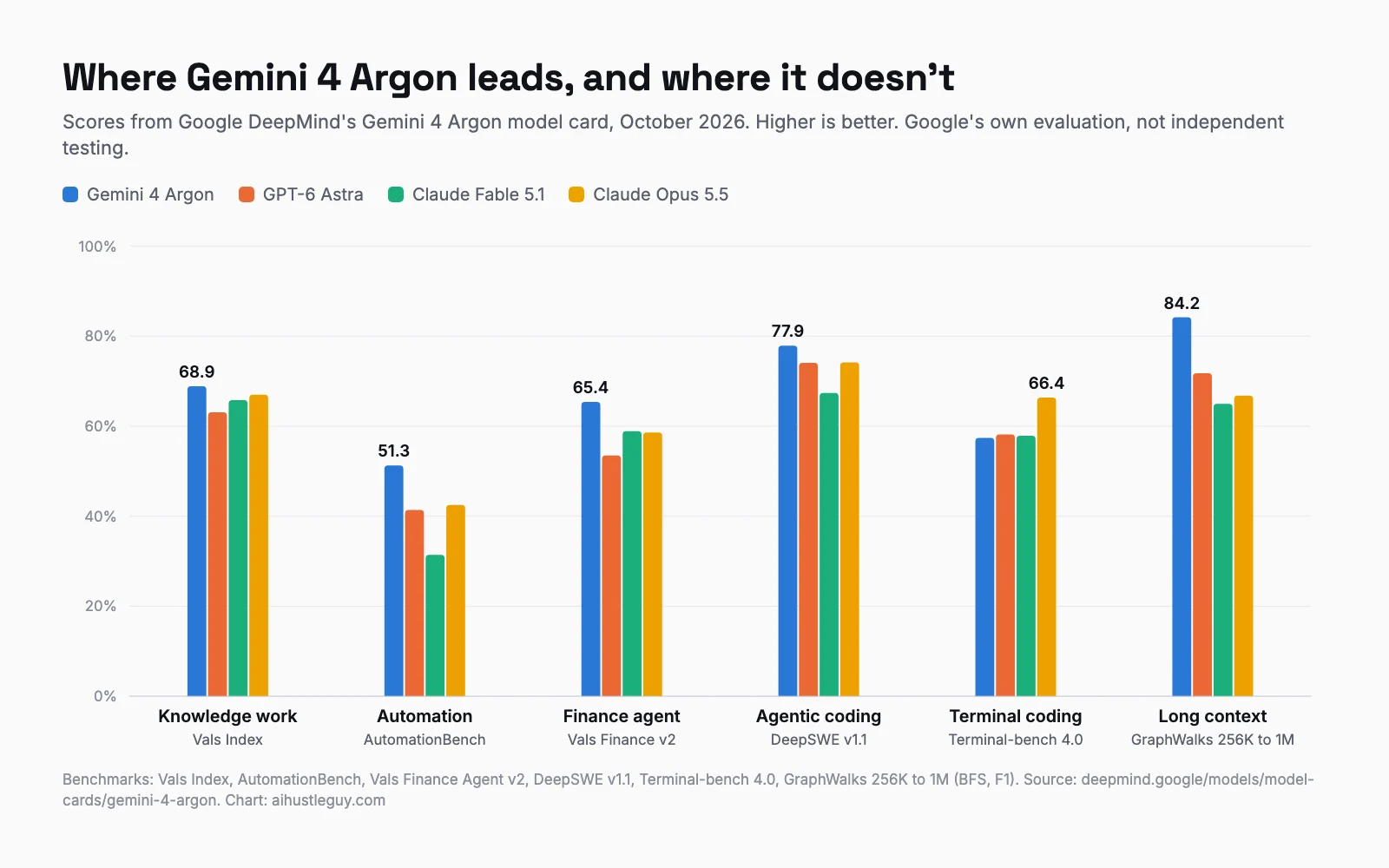
These are the numbers Google chose to publish, under configurations Google chose. I would not treat them as the final verdict. But the shape of the results is consistent enough to take seriously.
Where Argon leads
Knowledge work. The Vals Index is a broad test of professional tasks, and Argon tops it. The finance and legal agent results are the ones I would flag for anyone who runs a business: a lead of more than six points on the finance benchmark over the next-best model, and a legal result that is low in absolute terms but three to five times every competitor.
Automation. AutomationBench is Zapier's test of whether a model can build working multi-step automations. Argon's 51.3% is roughly nine points clear of Opus 5.5 and twenty points clear of Fable 5.1. For readers who want AI to actually run a workflow rather than describe one, this is the number to watch.
Long context. GraphWalks measures whether a model can actually use what is deep inside a huge prompt. Up to 128K tokens, every model is strong. Between 256K and 1M, Argon holds 84.2% while the others fall to the 65 to 72% range. If your work involves feeding a model entire books, codebases or months of records, that gap is real.
Video. LVBench is long-video understanding, and Argon's 91.7% is the best score on the card. None of the others accept video input as natively.
Where Argon does not lead
Terminal coding. On Terminal-bench 4.0, the benchmark closest to how I use Claude Code, Argon lands at 57.4% against 66.4% for Opus 5.5. Anthropic separately reports Sonnet 5.5, its cheaper model, at 70.6% on the same test. This is the row that keeps Claude as my coding default.
Harder software engineering. FrontierSWE v2 goes to GPT-6 Astra at 65.5%, with Opus 5.5 at 62.3%. Argon's 55.0% is its weakest coding result. Interesting detail: Argon wins DeepSWE, the benchmark Google chose to headline, by a clear margin. Both are agentic software engineering tests. Read the two together and the honest summary is "competitive, not dominant."
Computer use. Astra leads OSWorld-2.0 at 72.6%, and Anthropic's own OSWorld 2.1 result for Opus 5.5 is 81.8%, though that is a different version of the test and not directly comparable. Argon is in the pack, not ahead of it.
Science reasoning in a terminal. Terminal-Bench Science goes to Astra by ten points.
The independent view: Opus 5.5 leads, Argon ties the $10 models
Benchmarks from the company that built the model are the opening argument. Artificial Analysis runs the same evaluation suite across every lab, and its Intelligence Index is the closest thing we have to a neutral scoreboard.
As of October 13, 2026, the top of that board looks like this.
| Model (variant) | Intelligence Index | Average cost per task | Output speed |
|---|---|---|---|
| Claude Opus 5.5 (max) | 58 | $5.98 | 96 tokens/s |
| Claude Sonnet 5.5 (max) | 56 | $5.46 | 135 tokens/s |
| Claude Fable 5.1 (max) | 53 | $7.63 | 67 tokens/s |
| GPT-6 Astra (max) | 53 | $3.26 | 66 tokens/s |
| Gemini 4 Argon (high) | 53 | $1.99 | not yet measured |
| GPT-6.1 Sol (max) | 52 | $0.72 | 65 tokens/s |
| Grok 4.7 (xhigh) | 46 | $3.74 | 84 tokens/s |
| Gemini 3.1 Pro Preview | 30 | $1.30 | 134 tokens/s |
Source: Artificial Analysis leaderboard, checked October 13, 2026. Cost per task is Artificial Analysis's average cost per task across its Intelligence Index evaluations.
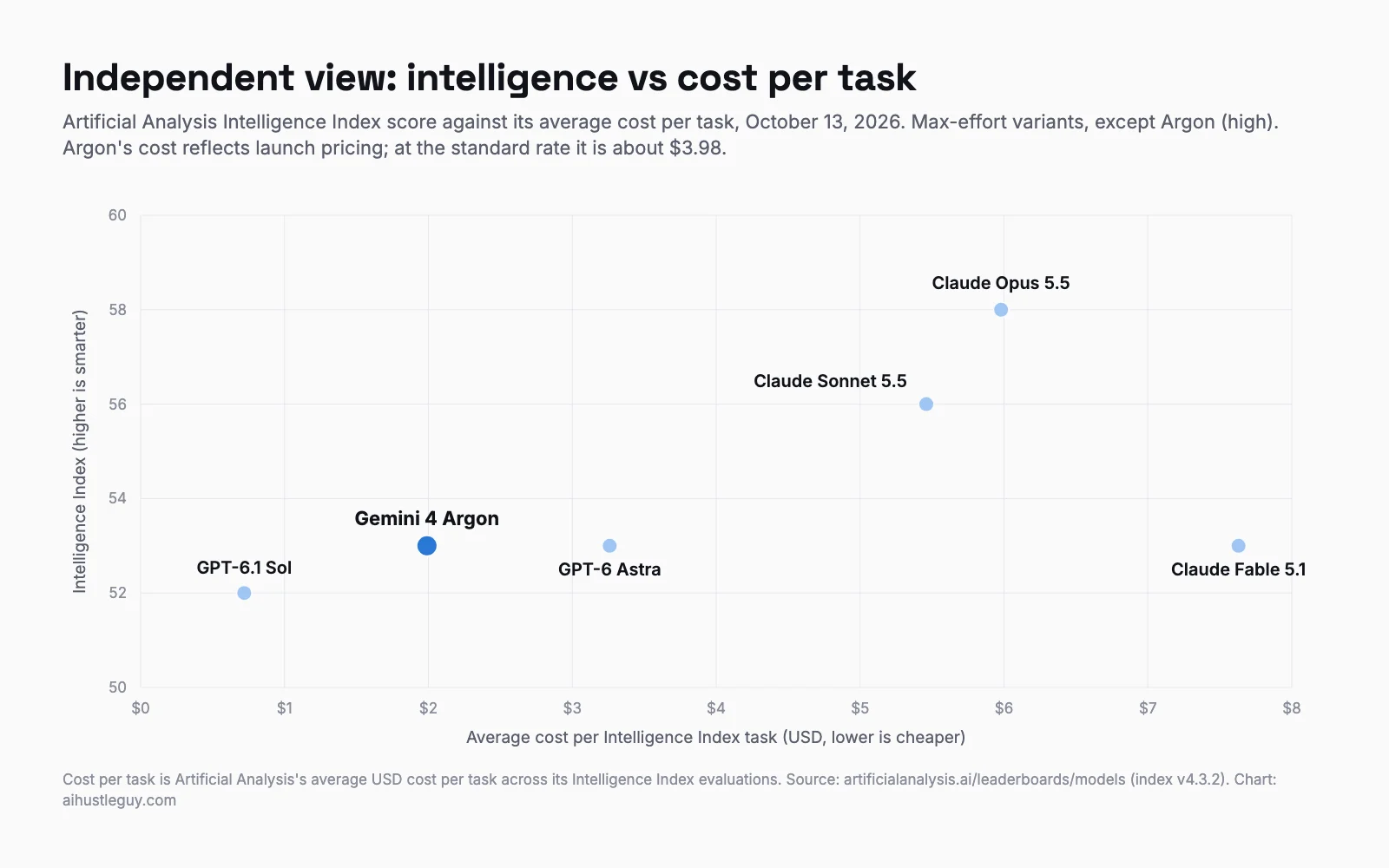
Three takeaways.
First, the Gemini jump is enormous. Gemini 3.1 Pro Preview scored 30 on this index. Argon scores 53. Google went from well behind the frontier to level with it in one release, which is why Artificial Analysis headlined its write-up as Google being back among the top three labs.
Second, Claude 5.5 still leads this index. Opus 5.5 at 58 and Sonnet 5.5 at 56 are both above Argon, Astra and Fable 5.1. One composite score is not the whole picture, but if you want the model that tests highest on the broadest independent suite, that answer did not change today.
Third, Argon is the value play among the $10-class models, for now. It ties Astra and Fable 5.1 on intelligence at about 60% of Astra's cost per task and about a quarter of Fable's. Only GPT-6.1 Sol is cheaper, one point lower, and at launch it was available in the API, Work and Codex rather than ChatGPT's regular chat.
Two cautions that Artificial Analysis itself raises. Argon is token-hungry: it averaged about 62,000 output tokens per task on this index against roughly 27,000 for Astra, so cheap token prices translate into a smaller per-task saving than you would expect. And that $1.99 is at launch pricing. At the standard rate from December 1, the same usage costs about $3.98 per task, which is above Astra's $3.26. The value argument is strong until November 30, 2026 and narrower after.
Also, Argon's score is for its "high" effort setting, and its output speed had not been measured when I wrote this. Google's own model card mentions occasional slowness and timeouts. Expect the speed column to fill in over the next week, and expect it to matter.
What Gemini 4 Argon costs, and why the date matters
API pricing per million tokens
| Model | Input | Output | Cached input | Notes |
|---|---|---|---|---|
| GPT-6 Luna | $0.10 | $0.50 | $0.01 | OpenAI's cheapest |
| Claude Haiku 5.5 | $0.10 | $0.50 | Up to 100K-token prompts | |
| Gemini 4 Argon (until Nov 30) | $2 | $10 | $0.10 | Doubles on Dec 1 |
| GPT-6.1 Sol | $2 | $10 | $0.10 | Rises above 272K input |
| Claude Sonnet 5.5 | $2 | $10 | $0.10 | |
| Gemini 4 Argon (from Dec 1) | $4 | $20 | $0.20 | |
| Claude Opus 5.5 | $4 | $20 | $0.20 | Fast mode $8 / $40 |
| GPT-6 Astra | $10 | $50 | $1.00 | $20 / $75 above 272K input |
| Claude Fable 5.1 | $10 | $50 | $0.25 |
Prices verified October 13, 2026 on the Gemini API, OpenAI and Anthropic pricing pages.
If you build anything on the Gemini API, the introductory window is the headline. Until November 30, 2026, Argon costs the same as Sonnet 5.5 and GPT-6.1 Sol. From December 1 it costs the same as Opus 5.5. Google has not said whether the promo will be extended, so price your product on the $4 / $20 number and treat the weeks until then as a discount.
Two details that bite people who skim the pricing page. Argon's thinking tokens are billed at the output rate, and they share the unified 1M window with everything else. A heavy reasoning task on a huge input can cost more than the input price suggests. And caching is implicit only; you cannot pin a context the way you can on Claude.
Consumer plans
| Plan | Monthly price | What you get |
|---|---|---|
| Google AI Pro | $19.99 | Gemini 4 Argon, 3.1 Pro and 3.8 Flash in the Gemini app; 4x the Free limits; Antigravity at entry limits, but not Argon inside it |
| Google AI Ultra | $99.99 or $199.99 | Same models at 5x or 20x the Pro limits, plus Argon in Antigravity and AI Studio |
| Claude Pro | $20 ($17 on annual) | Opus 5.5, plus Fable 5.1 through usage credits |
| Claude Max | from $100 | 5x or 20x Pro usage, Fable 5.1 at half the weekly limit |
| ChatGPT Plus | $20 | GPT-6 Astra only in Work and Codex (5 to 45 messages per 5 hours), not in regular chat |
| ChatGPT Pro | $100, $200 or $500 | GPT-6 Pro, powered by Astra, in chat |
This is the quiet shift in today's launch. For $20 a month, Google AI Pro and Claude Pro now both hand you a true frontier model in a chat app. ChatGPT Plus does not; OpenAI's help centre is explicit that Plus subscribers get Astra in Work and Codex but not in standard chat, and Astra in chat starts at the $100 Pro tier.
Gemini app usage limits refresh every five hours with a weekly cap, like Claude's. Google has not published the Argon message counts per plan. Plan prices checked October 13, 2026.
Gemini 4 Argon vs the field, task by task
Here is how I would route the work my readers actually do. Each section has a concrete example of the kind of prompt I mean, what the evidence says, and what I would open first.
Writing, content and repurposing
The job: "Take this 1,800-word blog post and turn it into a LinkedIn post, a five-email welcome sequence outline and ten hook variations, in my voice, using the three samples attached."
No public benchmark measures voice or taste, so this is the one area where I lean on experience over scores. Claude has been my pick for structured long-form and for keeping a brief in mind across a long document. ChatGPT remains the model I use to argue with my own draft. In my hands-on Gemini 3.0 review the 3.x line was fast and structured but needed fact-checking on real-world detail.
Argon's launch notes attack Gemini's old weaknesses directly: more direct answers, less hedging, less repetition, and a measured drop in unjustified refusals. The knowledge-work benchmark lead suggests the substance is there too.
What I'd do: keep your current writing model and run one week of real drafts through Argon side by side. If you live in Google Docs and Gmail, Argon has the integration advantage and is now worth the $19.99. If you want prompts to start with, my Gemini prompts for content creation and Gemini prompt engineering guide both transfer directly.
Research, strategy and the second opinion
The job: "Here are 12 competitor sites, three industry PDFs and our last two quarters of numbers. Tell me where our positioning is weak and what I should change first."
Argon leads the Vals Index, the broadest knowledge-work test on the card, and it leads long-context recall by a wide margin once the input passes 256K tokens. On the independent index, though, Opus 5.5 is five points clear of Argon, and Anthropic reports Opus 5.5 ahead of Fable 5.1 on Humanity's Last Exam with tools (67.7% vs 65.6%), one of the hardest general reasoning tests it publishes.
One practical note: Argon's knowledge stops at March 2026. For anything that moved this year, make it search or feed it the documents. The API includes 5,000 free Google Search grounding requests a month, which is a genuine advantage for research that needs current data.
What I'd do: Argon when the input is enormous or you need live Google data. Opus 5.5 when the reasoning is the hard part. And, as always, a second model to challenge the first one's conclusion.
Spreadsheets, finance and admin work
The job: "Here are 12 months of Stripe and PayPal exports and my expense sheet. Build a monthly profit and loss, flag anything unusual, and forecast the next quarter."
This is Argon's biggest lead on the professional benchmarks. Vals Finance Agent v2 is an agentic test of financial research and analysis, and Argon's 65.4% is roughly seven points ahead of Fable 5.1 and Opus 5.5 and twelve ahead of Astra. On the general professional-work side, Anthropic's GDPval-AA Elo for Opus 5.5 (1846 vs 1735 for Fable 5.1) is the strongest number any lab has published, so I would not write Claude off here.
What I'd do: Argon first for financial analysis of this shape, Opus 5.5 as the checker, and verify every number that will touch a decision. One benchmark does not cover every spreadsheet, and every one of these models still invents a figure occasionally.
"Do this for me": tasks, agents and automation
The job: "Every Monday, pull last week's bookings, draft the cleaner schedule and send me the guest messages for Friday arrivals to approve."
AutomationBench, built by Zapier, tests exactly this, and Argon's 51.3% leads Opus 5.5 by nine points on Google's card (Anthropic's own run put Opus 5.5 at 40.0%). The Gemini app pairs that with a chat-to-tasks toggle, so a task keeps running after you close the window, and 40-plus connected apps. For agents that operate a computer through the screen, the picture flips: Astra leads OSWorld-2.0 at 72.6%, and Anthropic's own OSWorld 2.1 result for Opus 5.5 is 81.8% on a newer version of the test.
What I'd do: Argon in the Gemini app for delegated tasks that live in Google Workspace and connected apps. Claude or Astra for anything that has to click through software. And supervise every agent until it has earned trust, whichever model runs it.
Coding and building things
The job: "Fix the booking widget on my Next.js site, add availability sync, and write the tests."
Four coding benchmarks, four different stories. Argon wins DeepSWE v1.1 (77.9%). Astra wins FrontierSWE v2 (65.5%), with Argon last of the four. Opus 5.5 wins Terminal-bench 4.0 (66.4%), and Sonnet 5.5 scores 70.6% on Anthropic's own run. Vibe Code Bench, the closest thing to "non-developer builds an app," is a four-way tie around 90%.
Where Argon is genuinely different is the output limit. A million output tokens in one run means a model can rewrite an entire codebase, or produce a full migration, without stopping every few thousand lines. Google's own example is a C++ to Rust port of 32,000 lines of SIMD code that ran 2.7x faster afterwards.
What I'd do: Claude Code with Opus 5.5, or Sonnet 5.5 for routine tickets, stays my default. I covered why in Claude Opus for founders and the logic has only strengthened with 5.5. If you are moving a large codebase or need a single enormous output, test Argon through the API with long decode, or in Antigravity if you are on an Ultra plan. If you already pay for ChatGPT Pro, Astra in Codex is strong. For vibe coding a landing page, any of the four will do; pick the one you already pay for.
Long documents, recordings and video
The job: "Here are three hours of workshop audio and 200 pages of transcripts. Turn them into a 12-module course outline with the strongest quotes attached to each module."
This is the clearest Argon win on the whole card. GraphWalks between 256K and 1M tokens: Argon 84.2%, Astra 71.8%, Opus 5.5 66.8%, Fable 5.1 65.0%. LVBench long-video understanding: 91.7%, best of the four. Argon takes audio and video natively, so the recordings go in as recordings, not as transcripts you had to generate first.
Two practical limits. In the Gemini app, Pro and Ultra uploads are capped at one hour of video or three hours of audio per prompt, so longer material gets split into batches or goes through the API. And the unified window means inputs and outputs share the 1M, with thinking tokens billed as output. A huge input plus a huge output in one run is possible, but budget for it.
What I'd do: Argon is my first choice here. This is the task where Gemini 3.1 Pro was already my pick, and the published long-context numbers widen the gap. The usual caveat applies: a recall benchmark measures whether the model finds the needle, not whether its judgment about the needle is right, so check its citations against the source.
If you're an Airbnb host
Hosting has three different AI jobs, and they route to different models.
- Guest messaging (check-in instructions, late checkout requests, review responses) does not need a frontier model. Gemini 3.8 Flash, Haiku 5.5 or GPT-6 Luna handle it for pennies. My AI prompts for Airbnb hosts work on any of them.
- Pricing and revenue analysis ("here are 18 months of bookings, cleaning costs and PriceLabs exports; where am I underpriced?") is finance-shaped work, the category where Argon posted its biggest benchmark lead.
- Listing audits from photos and walkthrough video are multimodal, and Argon's video result is the best on the card.
For the tools layer, pricing engines and messaging automation, see my Airbnb hosts hub and the best Airbnb tools for hosts. The model matters less than the system around it.
If you're planning travel
Argon's app connections are the practical change here: OpenTable and Instacart are connected today, and the API has Google Maps grounding with 5,000 free requests a month. My travel workflow has been "scout with Gemini for live prices and places, decide with ChatGPT on the tradeoffs," and I would now scout with Argon.
The prompts in my AI prompts to save money when booking travel guide run on any of these models, and the AI for travel hub covers the rest of the stack.
If you're job hunting or building a career
Resume rewrites, interview prep and role research are well within reach of any model on this page; the frontier differences do not show up on a bullet-point rewrite. What has changed is access, covered in the subscription section below: two of the three $20 plans now include a frontier model in chat.
The more valuable career move is learning to route work across models, which is one of the AI skills that actually pay right now.
Which subscription should you actually pay for?
If you are picking one $20 subscription today:
- Google AI Pro ($19.99) if your work lives in Google Workspace, you process long recordings or video, or you want delegated tasks and app connections. You get a true frontier model plus 3.1 Pro and 3.8 Flash for lighter work.
- Claude Pro ($20) if you write long-form, code at all, or want the model that currently tops the independent index. Opus 5.5 is included; Fable 5.1 is available through usage credits.
- ChatGPT Plus ($20) if your workflows, custom GPTs and memory already live there. Just know that GPT-6 Astra in chat starts at $100 a month.
If you can justify two, Google AI Pro plus Claude Pro is the strongest $40 in AI right now, and it covers most of the routing table above. The exceptions are computer-use agents, where Astra leads, and Argon inside Antigravity, which needs Ultra.
Caveats I'd want you to know
- Most of Argon's wins come from Google's curated table. The independent index confirms it is frontier-class; it does not confirm the individual benchmark margins.
- Speed is unknown. Artificial Analysis had not measured Argon's output speed when I wrote this, and Google lists slowness and timeouts as a known limitation.
- The price doubles on December 1, 2026. Plan on $4 / $20, and on a per-task cost above Astra's at that rate.
- The 1M window is shared, and the 1M output needs long decode. Input, thinking and output all draw from the same window, thinking is billed as output, and a normal request returns at most 65,536 tokens.
- Knowledge cutoff is March 2026. Use grounding or your own documents for anything newer.
- Safeguards apply. Google cannot rule out that Argon reaches its cyber and biology risk thresholds, so expect conservative handling in those areas, as with Opus 5.5 and Fable 5.1.
- It is day one. Every model on this page has had rough first weeks. Argon will too.
What I'd test before moving real work to Argon
- One real document over 300K tokens. Ask a question whose answer sits in the middle. This is the long-context claim, and it should be easy to confirm.
- One finance task with a known answer. Give it last quarter's numbers and check the P&L against your own.
- One delegated task through the chat-to-tasks toggle, with a step that touches a connected app.
- One writing task in your voice, side by side with whatever you use now.
- One timed run. Note the latency on each of the above. If the timeouts Google mentions show up for you, that is your answer for now.
My stack after today
- Difficult software work: Claude Code with Opus 5.5, Sonnet 5.5 for the routine. Unchanged.
- Second brain and independent challenge: ChatGPT. Unchanged.
- Huge inputs, recordings, video and finance analysis: Gemini 4 Argon. This slot belonged to Gemini 3.1 Pro, and on the published long-context numbers the upgrade is large.
- Cheap, repeated work: Haiku 5.5, GPT-6 Luna or Gemini Flash, whichever is already wired in.
- The hardest problems: Opus 5.5 first. I wrote my Fable 5.1 breakdown before Opus 5.5 existed, and Anthropic's own numbers now put Opus 5.5 ahead of Fable 5.1 on most of what I cared about, at 40% of the price. Fable 5.1 is the model I reach for when something stalls.
👉 Want to know what this stack should look like for your business? Start with my free AI audit: you tell me how you work, and I tell you which workflows AI should take off your plate first, and which tier of model each one actually needs. Free, no call, and it's how most of my done-for-you setup clients start.
FAQ
Is Gemini 4 Argon free?
No. In the Gemini app it is available to Google AI Pro ($19.99 a month) and AI Ultra (from $99.99 a month) subscribers, and the Free and AI Plus plans do not include it. In the Gemini API it is paid-tier only, at an introductory $2 per million input tokens and $10 per million output tokens through November 30, 2026, rising to $4 and $20 on December 1.
Is Gemini 4 Argon better than Claude Opus 5.5?
It depends on the job. On Google's own model card, Argon beats Opus 5.5 on knowledge work (Vals Index 68.9% vs 67.0%), automation (AutomationBench 51.3% vs 42.5%), finance analysis and long-context recall. Opus 5.5 beats Argon on terminal-style coding (Terminal-bench 4.0 66.4% vs 57.4%) and sits higher on the independent Artificial Analysis Intelligence Index (58 vs 53). For big documents, video and finance-shaped work I would try Argon first. For hard coding and the most demanding reasoning I would still open Claude.
Is Gemini 4 Argon better than GPT-6 Astra?
They tie on the independent Artificial Analysis index (53 each), and Argon costs about a fifth of Astra per token ($2/$10 vs $10/$50). Google's card shows Argon ahead on knowledge work, automation and long context, while Astra leads on computer use (OSWorld-2.0 72.6% vs 69.2%) and harder software engineering (FrontierSWE v2 65.5% vs 55.0%). Unless computer-use agents are your main workload, Argon is the better value today.
What is Gemini 4 Argon's context window?
A unified 1 million token window shared between input and output, with output of up to 1 million tokens in a single run, up from 64,000 on earlier Gemini models. It accepts text, images, audio and video and outputs text. Its knowledge cutoff is March 2026, so anything newer needs search grounding or documents you supply.
How much does Gemini 4 Argon cost?
API pricing is $2 per million input tokens and $10 per million output tokens through November 30, 2026, then $4 and $20 from December 1. Cached input is 95% cheaper, batch and flex processing are half price, and thinking tokens are billed at the output rate. For regular people, the practical price is $19.99 a month for Google AI Pro, which includes Argon in the Gemini app.
Should I switch from ChatGPT or Claude to Gemini 4 Argon?
Not wholesale. Add it where its strengths are clear: huge documents, long recordings and video, finance-style analysis and delegated tasks inside Google's ecosystem. Keep Claude for serious coding and the hardest reasoning, and keep ChatGPT if your workflow lives there. The cheapest way to get a true frontier model in a chat app today is Google AI Pro or Claude Pro at about $20 a month; ChatGPT Plus does not include GPT-6 Astra in normal chat.
Sources and methodology
Gemini 4 Argon facts come from Google's September 30 announcement, the Gemini app availability post and developer post published today, the Gemini 4 Argon model card, the Gemini API pricing page and the Google AI plans page. The full benchmark table above is reproduced from the model card.
Claude figures come from Anthropic's Opus 5.5, Sonnet 5.5 and Haiku 5.5 announcements and the Claude pricing page. OpenAI figures come from its API pricing page and help centre articles on GPT-6 in ChatGPT and Astra in Work and Codex. Independent scores are from the Artificial Analysis leaderboard and its Gemini 4 Argon launch analysis as of October 13, 2026. Gemini app upload limits are from Google's Gemini Apps help. GPT-6 Astra specifications are from OpenAI's model page.
Where I cite a benchmark result, it is the publishing lab's own evidence unless I say otherwise. Argon launched the day this article was written, so independent testing is thin. I used Argon myself the same day in the Gemini app on the Google AI Pro plan, on my own workflows, and the task-by-task calls reflect that first look alongside the published numbers. I will add fuller hands-on results and revisit the recommendations as the evidence matures, including after the December 1 price change, which alters the value argument rather than just the token price.
Keep going
- ChatGPT vs Claude vs Gemini: The Best AI Model for Your Business in 2026
- Claude Fable 5.1 vs Fable 5, GPT-5.6, Gemini & Grok: Which AI Model Should You Actually Use?
- Claude Fable 5 vs GPT-5.6 Sol: Who Wins Each Job
- I Tested Google's Gemini 3.0: Hands-On Review
- Gemini Prompt Engineering: The Complete Guide (2026)
- AI Skills That Actually Pay in 2026 (Ranked by Evidence)

Written by Jon Miksis
Founder of AI Hustle Guy, Make the Leap, and Europe Flight Club, and the travel blogger behind Global Viewpoint (9+ years, 73 countries). He brings 9+ years of coaching and mentorship experience and has facilitated 23 transformation retreats across four continents. Every AI tool and prompt on this site gets tested on his own businesses first.
Get my free AI prompt pack
Join 300+ founders, creators, and professionals. I’ll send you my go-to AI tools and copy-paste prompts that save hours every week. No spam.